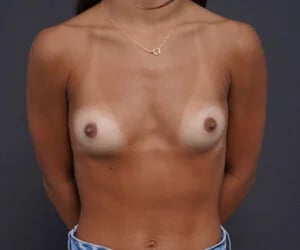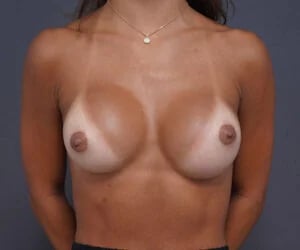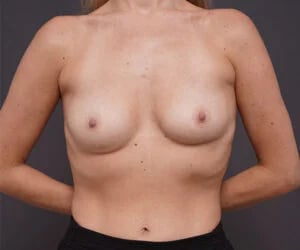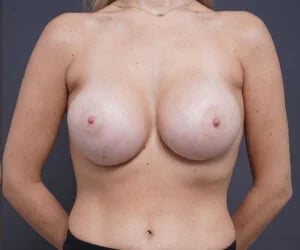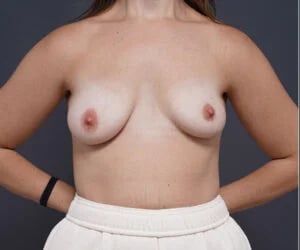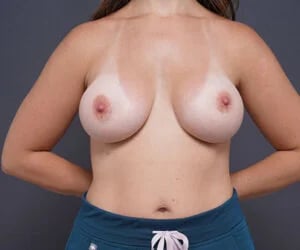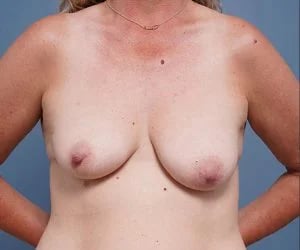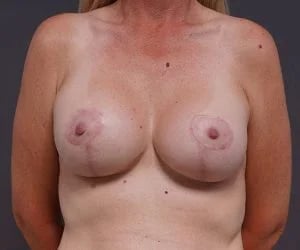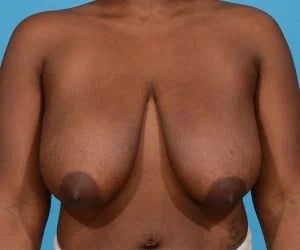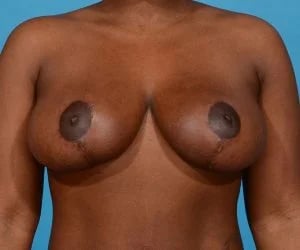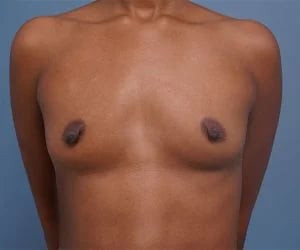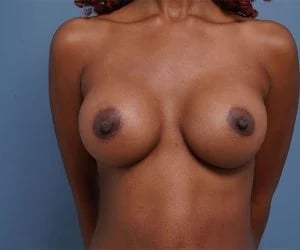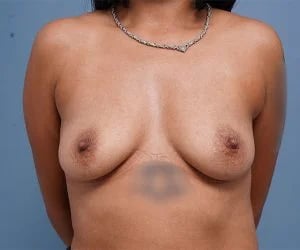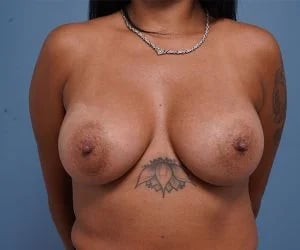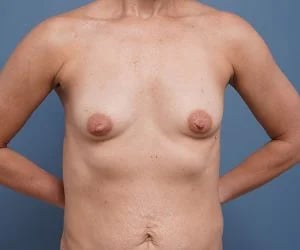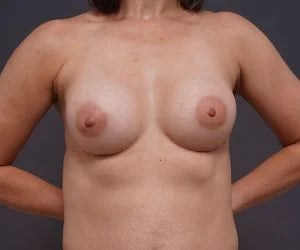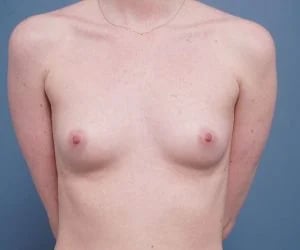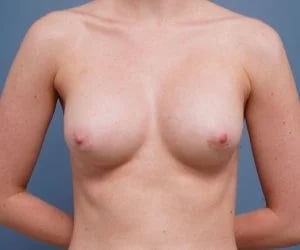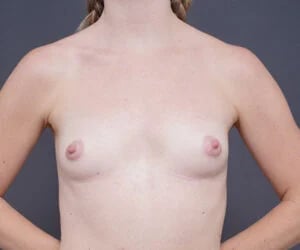
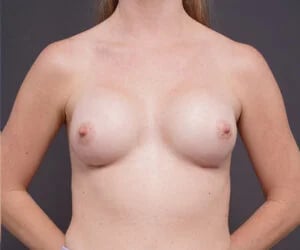
Individual results may vary.
Breast photographs look straightforward and carry more variables than most people realise.
Posture matters. Shoulders back and shoulders forward produce visibly different breast position. A genuine pair is shot with the same stance, arms in the same place, from the same camera height.
Lighting and background matter in the same way they do for facial photographs. Side lighting creates shadow beneath the breast that exaggerates projection, and flat lighting reduces it.
Weight matters. The breast is substantially fatty tissue, so weight change between the two photographs changes volume independently of any surgery.
And timing matters most of all, for reasons specific to breast surgery that are set out below.
After breast augmentation, implants sit high and look tight for a period before settling into their final position. The muscle relaxes, the tissue accommodates and the implant descends to where it will stay. Surgeons often describe this informally as dropping and fluffing, and it takes months rather than weeks.
This has a direct consequence for reading photographs. An image taken early shows a breast that looks higher, firmer and more rounded in the upper pole than that patient's settled result. An image taken once settling is complete shows something softer and lower. Both are honest, and they are not comparable with one another.
Scars follow their own, longer curve. A scar is typically at its most visible in the first few months and then fades and flattens over a year or more. A photograph at three months and one at eighteen months show the same incision at completely different stages.
When comparing galleries between practices, this is the variable most likely to mislead.
Patients often arrive at a gallery looking for a particular letter, and a letter is not a unit a surgeon can operate toward.
A cup letter describes a difference between two measurements and means something different at every band size. There is no manufacturing standard, so the same person can be fitted differently in two shops. What determines a result instead is the volume used, the patient's existing tissue, the dimensions of the chest, and where the implant sits.
The practical effect is that two patients can receive similar implants and look quite different, and two patients can look similar having received very different volumes. Looking for a case whose starting point resembles yours is more informative than looking for a case whose finished size matches the letter you have in mind.
The practice covers breast augmentation along with small breast augmentation for patients wanting a more modest change, and awake breast augmentation for those interested in surgery under local anesthesia.
Augmentation. Results from implant surgery, best read with attention to upper pole fullness, cleavage spacing and how natural the transition looks at the top of the breast. The breast augmentation gallery holds these cases.
Lift, and lift with implants. Results from breast lift and breast lift with implants, where the thing to look at is nipple position relative to the fold beneath the breast. A lift raises the nipple and tightens the skin envelope. An implant adds volume. They solve different problems and are often combined, and the lift gallery shows cases of both.
Reduction. Results from breast reduction, where scars are part of the honest picture and worth looking at directly rather than past. The trade is well established: reduction buys relief from the symptoms of excess weight at the cost of incisions. The reduction gallery shows these cases.
Revision and implant removal. Results from breast revision and implant removal, which covers patients having implants exchanged, repositioned or taken out entirely. These cases vary more than any other category because the starting point varies more.
Gynecomastia. Results from gynecomastia surgery for male patients, where the chest contour and the position of the nipple relative to the chest wall are the variables.
The article on whether breast implants last forever is useful background for anyone considering augmentation or revision.
Different operations leave different incisions, and a gallery is the place to see that honestly.
Augmentation incisions are comparatively short and placed where they can be concealed. Lift and reduction incisions are longer, because removing skin requires cutting it, and the pattern depends on how much skin is being removed.
No surgeon can promise an invisible scar. What can be influenced is placement, closure technique and aftercare, and what varies between patients is how their skin heals, which is partly genetic.
Judging scars from a gallery requires knowing when the photograph was taken, which is why the timing section above matters here too.
Every photograph in this gallery shows one patient's outcome and is not a prediction, a guarantee or an indication of a typical result.
Breast surgery outcomes depend on starting tissue volume and quality, chest dimensions, skin elasticity, whether the patient has been pregnant or breastfed, weight stability and individual healing. Two patients having the same named procedure can reach very different results, both appropriate for them.
Photographs show results. Patient testimonials describe the experience.
Background on Dr. Justin Bellamy is on his profile page, and the about section covers the practice, including awake surgery for patients interested in procedures under local anesthesia.
The full photo gallery covers every category, including face and body.
The practice is in Palm Beach Gardens, Florida. An examination establishes what is realistic for your anatomy, which a gallery cannot. Appointments can be arranged through the contact page.
Because implants sit high and feel tight for a period after surgery before settling into their final position, as the muscle relaxes and the tissue accommodates. The process takes months rather than weeks. A photograph taken early shows a breast that looks higher, firmer and rounder in the upper pole than that patient's settled result, so early and late photographs of the same patient are not comparable with one another.
Not reliably, because a cup letter is not a unit surgery works in. A letter describes a difference between two measurements and means something different at every band size, and there is no manufacturing standard between brands. What determines the result is the volume used, the existing tissue, the chest dimensions and where the implant sits. Looking for a case whose starting point resembles yours is more useful than looking for a finished letter.
It depends on the operation and on individual healing. Augmentation incisions are comparatively short and placed to be concealed. Lift and reduction incisions are longer, because removing skin requires cutting it. No surgeon can promise an invisible scar. Placement, closure and aftercare can be influenced, while how a particular person's skin heals is partly genetic. Scars also typically look their worst in the first few months before fading over a year or more, so the age of a photograph matters.
They solve different problems. A lift raises the nipple and tightens the skin envelope, so look at nipple position relative to the fold beneath the breast. An implant adds volume, so look at upper pole fullness. Many patients have both in one operation, and the gallery includes cases of each.
No. Each photograph shows one patient and is not a prediction or a guarantee. Outcomes depend on starting tissue volume and quality, chest dimensions, skin elasticity, pregnancy and breastfeeding history, weight stability and individual healing. What is realistic for you is established at an in-person assessment.
Individual results may vary.


© 2026 Justin Bellamy, MD