

Facial fat grafting in Palm Beach, FL
Ask a plastic surgeon what changes most in an aging face and many will say volume, not just skin. The cheeks flatten, the temples hollow, the area beneath the eyes darkens and the lips thin. Filler can replace some of that, but it is temporary. Facial fat grafting uses your own fat to rebuild it, and when it takes, it can last far longer than filler.
Dr. Justin Bellamy uses fat grafting as one way to rebuild the contours of an aging face, alongside lifts and injectables, and patients travel from across the country for his facial work. This page covers what the procedure is, what it can treat, how it compares with filler and what recovery and results look like.
What facial fat grafting is
Facial fat grafting goes by several names: fat transfer, micro-lipoinjection, facial fat rejuvenation, autologous fat transfer and fat injection. They all describe the same idea. Fat from one part of your body is moved to your face to restore lost volume and soften creases, and to correct concerns such as scars.
The process has three steps. First, fat is harvested from a donor area with liposuction. Common donor areas are the abdomen, arms, flanks and inner thighs. Then Dr. Bellamy processes the fat to remove damaged cells, keeping the healthy ones. Finally, he places the healthy fat into the areas of the face that need it.
The grafted fat has to develop a new blood supply to survive. Not all of it will. About 60 to 80 percent of transferred fat typically survives, which means some patients need an additional treatment to reach the result they want.
What it can treat
Facial fat grafting is versatile. It is often used to:
- Reduce shadows beneath the eyes
- Restore fullness to the cheeks
- Enhance thin or deflated lips
- Soften creases and smooth fine lines
- Address marionette lines
- Improve the appearance of scars
- Redefine the jawline, a weak chin and jowls
- Correct hollowing at the temples or cheeks
Because the result comes from your own tissue, it tends to feel soft and blend naturally with the surrounding face.
Fat grafting versus filler
Both add volume, so people often wonder which to choose. The difference is mainly in how long they last and how much is involved.
Dermal fillers are quick and predictable. You walk in and out in less than an hour, the result appears right away and it lasts from about six months to two years. Then it needs repeating. Fat grafting is a surgical procedure that takes longer and has a longer healing process, but when it takes, the results typically last for years longer than filler. It also uses your own tissue, so there is no foreign material.
Filler is often the right first step for early volume loss and for patients who want minimal downtime. Fat grafting suits patients who want a longer-lasting correction, who have enough donor fat to work with and who are willing to accept a short recovery. Some patients use both, filling small areas with product and rebuilding larger ones with fat.


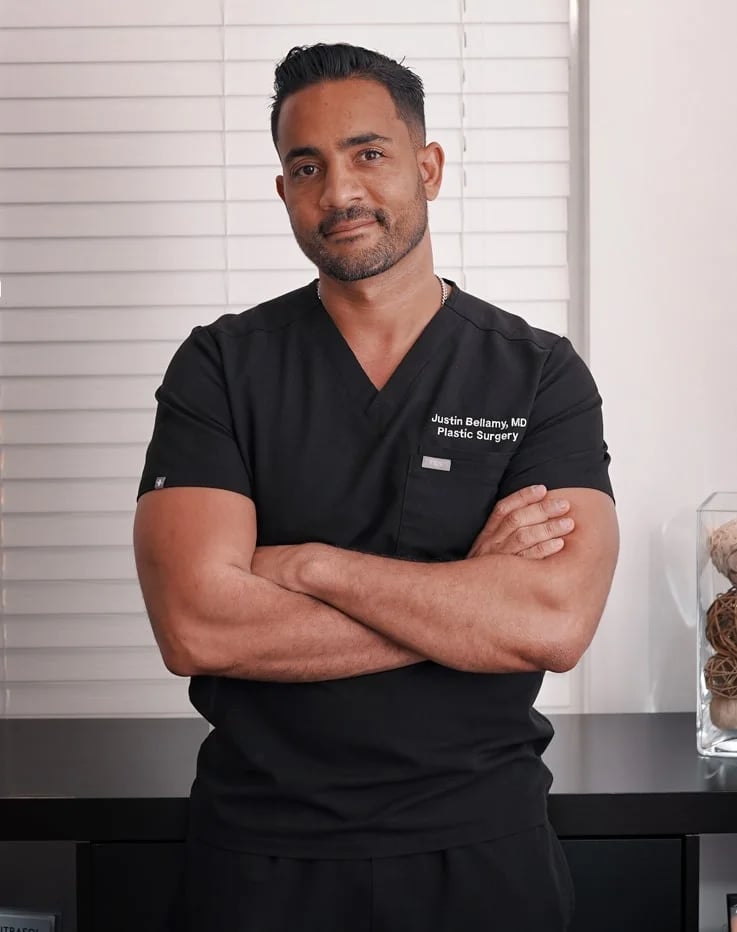
Looking for the best plastic surgeon in Palm Beach?
Dr. Justin Bellamy uses his esteemed education, cutting-edge techniques, and state-of-the-art medical equipment to create customized treatment plans to meet his patients’ needs and expectations. He has published over thirty peer-reviewed articles and book chapters and is a thought-leader in the field of plastic surgery. Trust Dr. Bellamy for a comprehensive and modern plastic surgery experience.
Is it a substitute for a facelift?
No. Fat grafting restores volume, but it doesn't lift sagging skin or reposition descended tissue. If your main issue is loose skin and drooping, a facelift does what fat can't. That said, the two work beautifully together. Many facelift patients also have fat grafting to restore fullness in the temples and cheeks that the lift alone can't replace, which is why it is often part of a complete facial rejuvenation plan.
Do you have enough fat, and enough need?
Facial fat grafting is a two-sided question. On one side is the face: is volume loss the main thing bothering you? On the other is the body: do you have somewhere to harvest fat from? Patients near their ideal weight who also carry a bit of stubborn fat in the abdomen, flanks, arms or inner thighs are ideal, since those areas double as donor sites. Very lean patients may not have enough to work with.
Beyond that, the usual health conditions apply. You should be at a steady weight, in good general health and free of anything that impairs healing. If you are pregnant or breastfeeding, wait. And it helps to hold realistic expectations about what fat can do. It restores volume beautifully. It won't lift sagging skin, and it isn't a route to weight loss, since fat grafting and liposuction are contouring procedures.
Planning the graft
Planning starts with your face: where volume has been lost, how deep the hollows are and how your features move. Dr. Bellamy then looks at your body to see which donor sites are available. He reviews your medical history and talks about your goals, and gives an honest recommendation about what is anatomically achievable.
Together you decide which areas to treat and whether fat grafting is the right tool or whether filler, a lift or a combination would serve you better.
Why the way fat is handled matters
Fat is a living tissue, and how it is harvested, processed and placed affects how well it survives. Gentle harvesting protects the cells. Processing removes the damaged ones, along with oil and fluid, so that what goes into the face is the healthiest part. Placement is done in small amounts, layer by layer, so each deposit sits close to a blood supply and doesn't form clumps.
This is one reason fat grafting is a surgical skill, not a simple injection. The same volume of fat placed differently can survive or not, and it can look smooth or lumpy. Dr. Bellamy's approach aims for a soft, even contour that looks like your own face, only fuller.
Risks and what can go wrong
Every surgery has risks, and fat grafting has its own. They include bruising and swelling, infection, contour irregularities or lumpiness, asymmetry, uneven fat survival and, occasionally, a need for a second treatment. Fat placed in the face can also, very rarely, enter a blood vessel, which is a serious complication that is one reason technique and experience matter here.
Some patients also feel that their face looks fuller than they wanted, particularly in the first weeks when swelling adds to the volume. Dr. Bellamy will explain what is normal and what to expect at each stage, and he checks your progress at follow-up visits.
What if some of the fat does not take?
Because some of the graft is absorbed, results are built with that in mind. Dr. Bellamy places enough to allow for it without overfilling. If, after healing, an area still needs more, a touch-up can be done, and small areas can sometimes be adjusted with filler. It is worth knowing this up front so the two-month result doesn't come as a surprise.
Surgical Mastery Meets Aesthetic Artistry
Looking at fat grafting results
Facial fat grafting results are subtle by design, so photos need a careful eye. Look at the cheeks and under the eyes for smoother transitions and softer shadows, and at the temples for lost hollows. Compare how the face looks at rest and in different expressions. Dr. Bellamy's facelift and neck lift before and after photos often show the effect of comprehensive rejuvenation, where volume restoration is part of the plan.
Combining fat grafting with other treatments
Fat grafting can be combined with other facial procedures. It pairs naturally with a brow lift or eyelid surgery for upper-face balance, and with a neck lift for the lower face. Skin quality is part of the picture too. Dr. Bellamy may also recommend laser skin resurfacing, Morpheus8 skin tightening or intense pulsed light treatments to optimize the result.
Preparation
In the weeks before surgery, Dr. Bellamy advises protein-rich, low-salt meals. Stop medicines containing aspirin and most herbal supplements, especially garlic, fish oil and zinc, since they can increase bleeding and bruising. Nicotine of every kind stays off for at least four weeks before and after, and there is a graft-specific reason for that rule: nicotine restricts the blood vessels the transferred fat needs in order to survive.
In the operating room
Surgery takes place in the practice's own facility with two AAAASF-certified operating rooms. After a last review of the plan and surgical markings, Dr. Bellamy harvests fat from your donor site with liposuction, then processes and purifies it. He places the healthy fat in the areas of your face you have chosen, adjusting as he goes. It takes about two to three hours, depending on how much you're treating, and you'll go home the same day with someone to stay with you for the first day.
Two places to heal: the face and the donor area
Unlike fillers, a fat graft leaves you with two areas to look after. The face is swollen and often bruised, and the donor site can feel sore, bruised and tight. Both improve over a few days to a few weeks, and a compression garment on the donor area may be advised to limit swelling.
Many patients take about one week off work, and strenuous exercise and heavy lifting wait for four weeks. Walking is encouraged from the start. Don't be alarmed if your face looks fuller than you expected at first. Swelling adds to the volume you've placed, and it settles as you heal.
Judging the result
Some improvement is visible right away, and it continues as swelling resolves. Because some of the transferred fat is absorbed, the final result becomes clear at about two months. From there, the outcome can last for years. Keeping your weight stable and looking after your skin help it last.
How the price is built
The cost depends on how many areas of the face you treat, which donor sites are used and whether you combine fat grafting with other work. Dr. Bellamy's team gives you an estimate after your consultation, so it reflects your plan and not an average.
Next step
To find out whether your face and body suit fat grafting, book a consultation or call (561) 705-0044. Dr. Bellamy sees patients in Palm Beach Gardens, and many come from West Palm Beach, Jupiter and Boca Raton.
Frequently Asked Questions
What is facial fat grafting?
It is a procedure that moves fat from another part of your body, harvested by liposuction, to your face to restore lost volume. It is also called fat transfer, micro-lipoinjection or autologous fat transfer.
Where does the fat come from?
Common donor areas include the abdomen, arms, flanks and inner thighs. At your consultation, Dr. Bellamy assesses which donor sites are available and best suited to you.
What areas of the face can be treated?
Fat grafting can restore volume to the cheeks and temples, reduce shadows under the eyes, enhance the lips, soften creases and marionette lines, improve scars and redefine the jawline, chin and jowls.
How much of the transferred fat survives?
About 60 to 80 percent typically survives, since the grafted fat must establish a new blood supply. Because of that, some patients need an additional treatment to reach the result they want.
How long does fat grafting last compared with filler?
The healing process is longer than filler, but results typically last years longer. Filler generally lasts about six months to two years and needs repeating.
How long is recovery after facial fat grafting?
Swelling and bruising usually resolve in a few days to a few weeks. Most patients take about one week off work and avoid strenuous activity for four weeks.
When will I see my final result?
You will notice improvement right away, but because some fat does not survive, the final result is clearest at about two months.
Can fat grafting replace a facelift?
No. Fat grafting restores volume but does not lift sagging skin. It works well with a facelift, which repositions tissue, by restoring fullness the lift cannot.
Will fat grafting help me lose weight?
No. Fat grafting and liposuction are body contouring procedures, not weight loss procedures, and neither leads to significant weight loss.
Am I a good candidate?
Healthy non-smokers near their ideal weight who have volume loss in the face and enough donor fat are generally good candidates. Dr. Bellamy assesses your facial anatomy, donor sites and medical history at your consultation.
Is facial fat grafting painful?
You are comfortable during the procedure, and afterward most patients describe soreness at the donor area and tightness in the face rather than sharp pain. Dr. Bellamy prescribes medication as needed, and discomfort usually eases within days.
What are the risks of fat grafting?
They include bruising, swelling, infection, contour irregularities, asymmetry and uneven fat survival. Very rarely, fat can enter a blood vessel, which is a serious complication and one reason technique and experience matter.
Can fat grafting be combined with a facelift?
Yes, and it is common. A facelift lifts and repositions tissue, while fat grafting restores volume in areas like the temples and cheeks that lifting can't replace. Dr. Bellamy will tell you what is sensible to combine in your case.