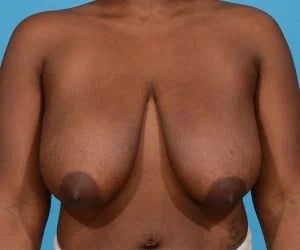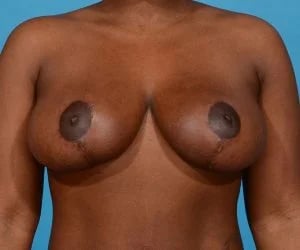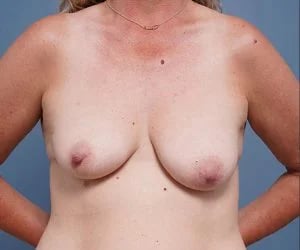
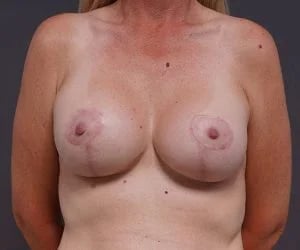
Browse breast lift and breast lift with implant results from Dr. Justin Bellamy's Palm Beach Gardens practice. Below the photos, you'll find a plain-language guide to what a breast lift does, who it suits and what recovery involves.
A breast lift, medically called mastopexy, raises and reshapes breasts that have lost their position. Over time, pregnancy, breastfeeding, weight changes and simple aging stretch the skin and the supporting tissue. The breast sits lower on the chest, and the nipple may point downward. A lift removes excess skin, tightens the tissue and moves the nipple and breast to a higher position.
Here's what a lift does not do: it doesn't add much volume. If you'd like a fuller upper breast as well as a higher one, the plan may include an implant, which is where the "breast lift with implants" in the gallery name comes from. Dr. Justin Bellamy explains both routes at his Palm Beach Gardens office, and the photos above show what patients have looked like before and after.
This is the most common question in a breast lift consultation, and the answer comes from examining you, not from a rule. A rough guide:
If you have mild sagging and want size, sometimes an implant alone will do the job. If you have more significant droop, an implant alone can make the breast look bigger and lower at once, which usually isn't what patients are after.
The degree of droop is judged by where the nipple sits compared with the crease under the breast. Mild sagging leaves the nipple at or slightly above the crease. Moderate to severe sagging brings it well below. The more the breast has dropped, the more skin has to be removed and the longer the scars.
Skin quality matters too. Skin that's thin or stretched has less recoil, so the result may not hold as long. Your surgeon will examine your skin's elasticity, the shape of your breast and the position of the nipple, and then describe which technique fits.
A breast lift leaves scars. That is the trade-off for lifting tissue. The pattern depends on how much lift you need:
Scars fade with time. Most are red or pink for the first few months and become paler and flatter over a year or more. How yours heals depends partly on your skin, and partly on following your care instructions. If you tend to form thick or dark scars, tell your surgeon early.
Many patients ask about anesthesia before they ask about anything else. Dr. Bellamy offers awake approaches in some procedures, which avoid general anesthesia. Whether an awake approach fits a particular breast lift depends on the extent of the surgery, your health and your preferences, and that's a decision made at your consultation.
Cup letters are a poor way to describe what you want, because they vary from brand to brand and even from style to style. Photos work better. Bring a few images of breast shapes that appeal to you and explain what you like: fuller on top, a more natural slope, a certain nipple position. If implants are part of the plan, sizing is discussed in volume, not letters, and trying sizers in a bra during your consultation can make it much more concrete.
It's also worth talking about what you want to keep. Some patients want to stay close to their current size and just have things lifted. Others want a noticeable change. Neither goal is more valid than the other, but clarity helps.
Every operation carries risk, and a good surgeon will tell you what they are without hurrying past them. For a breast lift, the possible issues include bleeding or a collection of blood under the skin, infection, delayed healing at the points where incisions meet, changes in nipple sensation, visible scarring and some degree of asymmetry. Very rarely, the blood supply to the nipple can be affected. When implants are added, there are implant-specific considerations too, such as capsular contracture, where scar tissue tightens around the implant.
Smoking and nicotine raise the risk of wound-healing problems considerably, which is why surgeons ask you to stop well before surgery. Choosing an experienced surgeon and following your instructions closely are the two best ways to lower your risk.
Preparation is simple but it does matter. Your surgeon may ask for a mammogram or breast imaging before surgery, depending on your age and history. You'll be asked to stop nicotine and to pause certain medications and supplements that can increase bleeding. Set up your recovery space in advance: extra pillows, easy-to-reach essentials and front-closing tops that don't require lifting your arms. Arrange for someone to drive you home and stay with you for the first night.
Buy your post-surgical bras only after your surgeon tells you what type and size to get, since sizes change with swelling.
Recovery from a breast lift is usually more comfortable than people fear. It's typically described as soreness and tightness more than sharp pain, and most patients manage well with the medication provided.
You'll wear a supportive bra or dressing for several weeks. Many patients return to desk work within about a week or two, although you'll need to avoid lifting and strenuous activity for longer. Swelling and bruising fade over the first few weeks, while the shape continues to settle over several months as the breasts drop into their final position and the tissue softens.
Nipple sensation can change after a lift, either temporarily or occasionally permanently. It's one of the risks to discuss beforehand. Your surgeon will go over all of them during your consultation, including bleeding, infection, scarring and asymmetry.
A breast lift can often be done in a way that preserves the ability to breastfeed, but it can't be guaranteed. If you plan to have children, tell your surgeon. Most surgeons recommend waiting until you're finished having children, since pregnancy and breastfeeding change the breasts again and can undo some of the lift.
A lift is long-lasting but not permanent. Gravity, aging and weight changes keep working on the tissue. Patients who maintain a stable weight, wear supportive bras during exercise and avoid smoking tend to keep the result longer. Heavier breasts also tend to descend faster than lighter ones, and skin that was already thin or stretched before surgery has less to hold the new shape. That's not a reason to avoid a lift. It's a reason to have a candid talk about what your particular result is likely to do over time. If implants are included, they are not lifetime devices, and you can read more in our post do breast implants last forever.
Look for board certification, an accredited surgical facility and plenty of breast lift experience. Look at healed photos, and pay attention to shape, nipple position and how the scars have settled.
A breast lift is often combined with other work. Some patients pair it with a tummy tuck as part of a mommy makeover. Others need a breast reduction to bring size and position into balance, or breast revision surgery if they've had implants before. Your consultation will help sort out which fits.
At your visit Dr. Bellamy will examine you, discuss your goals and show you photos of similar cases. You'll leave with a clear plan, a timeline and answers to your questions. Ready to talk it through? Request a consultation or call (561) 705-0044. The office is at 2865 PGA Boulevard, Suite 100-A, in Palm Beach Gardens, serving patients from West Palm Beach, Jupiter, Boca Raton and beyond.
A breast lift raises and reshapes breasts that have dropped by removing excess skin and repositioning the tissue. Augmentation adds volume with implants. They can be done separately or together, and which you need depends on how much your breasts have descended and how much fullness you want.
A lift alone usually keeps your size similar, and it may look a bit smaller because the tissue is gathered higher on the chest. If you want more volume, an implant can be added at the same time. Dr. Bellamy will talk through this with you at your consultation.
It depends on how much lift you need. Scars can be around the areola only, around the areola and down to the crease, or around the areola, down and along the crease. They fade over a year or more. Your surgeon will show you which pattern applies to you.
Many patients return to desk work within about one to two weeks, and avoid heavy lifting and strenuous exercise for longer. Swelling fades over the first weeks, and the final shape settles over a few months. Your surgeon will give you a timeline that fits your operation.
Often yes, but it cannot be guaranteed. Techniques can help preserve the milk ducts, and many women do breastfeed after a lift. If you plan to have children, most surgeons recommend waiting until you are done, since pregnancy can change the breasts again.
Dr. Bellamy offers awake approaches for some procedures, and the awake surgery page explains how it works. Whether it fits a breast lift depends on the extent of the surgery and your health, so it's something to raise at your consultation.
A lift is long-lasting, but gravity, aging and weight changes continue to affect the breasts. Keeping a stable weight, wearing good support during exercise and not smoking all help results last longer. Many patients enjoy the improvement for many years.
Sensation can change after a lift. Some patients notice temporary numbness or tingling that improves over weeks to months, and a small number have a lasting change. Your surgeon will discuss this risk and how they work to reduce it.
Look for board certification, plenty of breast surgery experience and healed before and after photos of patients similar to you. Consider seeing two surgeons before you decide. Dr. Bellamy's Palm Beach Gardens office serves patients from West Palm Beach, Jupiter, Boca Raton and other parts of Florida.
Yes, many patients do as part of a mommy makeover. Combining reduces the number of anesthetics and recovery periods, though longer surgeries carry some added risk. Dr. Bellamy will let you know what can be combined safely for you.
Individual results may vary.


© 2026 Justin Bellamy, MD