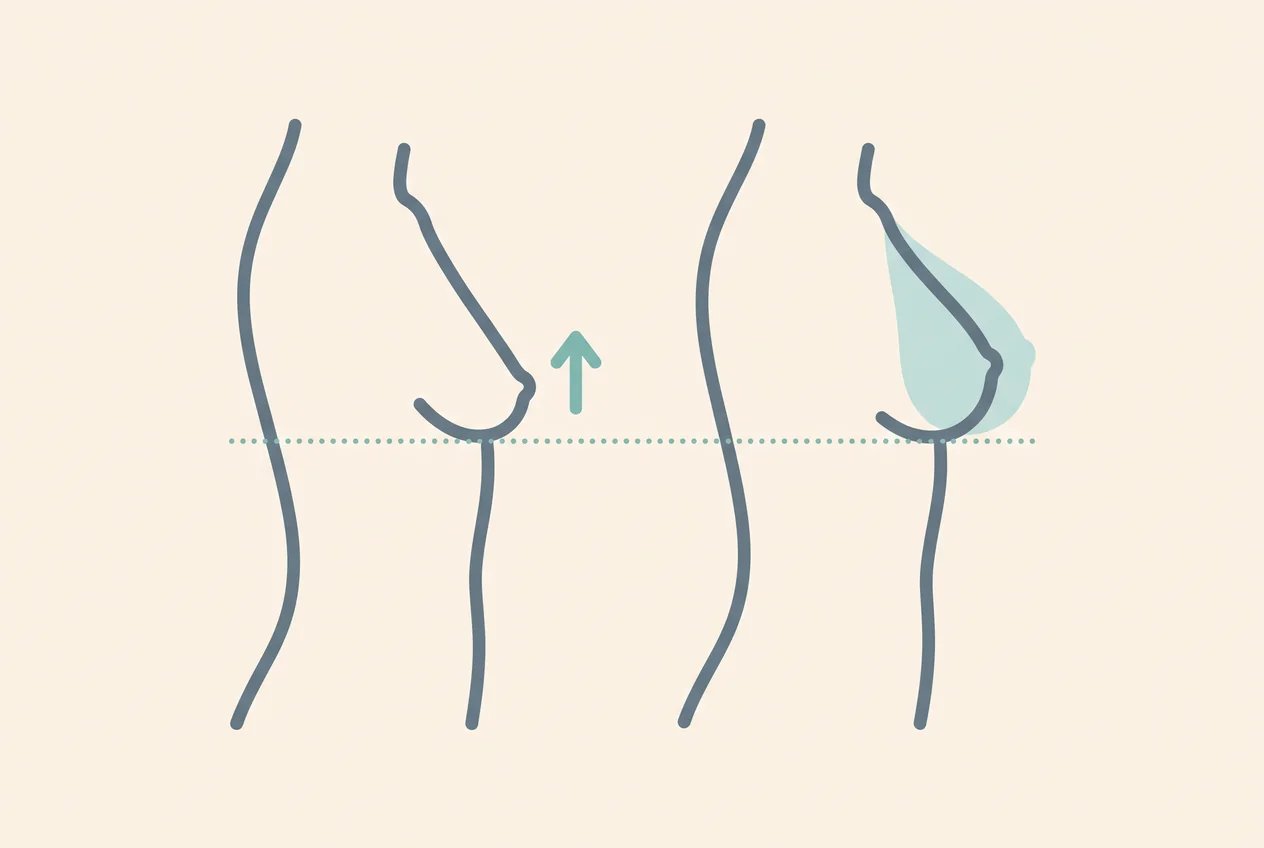
A common consultation story goes like this. A woman in her thirties or forties, often a few years after having children or after a significant weight change, stands in front of the mirror and sees a breast that has lost its fullness at the top and settled lower on the chest. She has done the research and arrives sure of one thing: she wants implants. Twenty minutes later, after an examination, the conversation takes a turn. The problem is not only that she wants more volume. The problem is that the breast has moved down, and the nipple has moved with it. An implant alone would add size without fixing the position, and in some cases would make the droop look worse.
The reverse story is just as common. A patient who is convinced she needs a lift because her breasts look deflated learns that her nipple position is still good and that what she is missing is upper pole fullness. A modest implant, with no scar beyond the incision for placement, may give her the shape she is imagining. The point is that sagging breasts are not one problem, and the question “lift or implants” cannot be answered from a photograph on social media. It can be answered by measuring where the nipple sits, how much skin there is and what you actually want to see in the mirror.
Why “sagging” is really three different problems
When people say their breasts sag, they may be describing any of three distinct changes. The first is loss of volume. Pregnancy, breastfeeding, weight loss and aging can all shrink the glandular tissue, so the breast feels deflated and looks flat at the top. The second is stretching of the skin envelope. The skin loses elasticity, so the breast tissue, even if the volume is unchanged, settles lower. The third is descent of the nipple and areola, which move downward relative to the fold under the breast and sometimes point toward the floor.
These changes often occur together, but not always in the same proportions, and the proportions decide the operation. A breast with mainly volume loss and decent skin is a candidate for implants. A breast with good volume and a descended nipple is a candidate for a lift. A breast with both, which is the most common pattern after pregnancy, may need a lift and an implant together. A fourth situation, which can be confused with sagging, is a breast that is simply too large and heavy, in which case reduction rather than lift or implant may be the right operation, as the discussion of breast reduction explains.

The nipple position test
Surgeons use a simple anatomical landmark to grade sagging. It is the relationship between the nipple and the crease under the breast, called the inframammary fold. You can approximate it at home, though only an examination gives a reliable answer. Stand in front of a mirror, relaxed and with your arms at your sides. Look at where the nipple sits relative to the fold.
If the nipple is at or slightly above the level of the fold and the breast tissue is mostly above it, the position is good. If the nipple sits at the level of the fold, that suggests mild descent. If it sits below the fold but the breast tissue still extends below the nipple, that is moderate descent. If the nipple points down and sits well below the fold, with most of the breast tissue hanging below it, that is more advanced. There is also a situation called pseudoptosis, where the nipple remains at or above the fold but the breast tissue has slipped below it, which commonly occurs after weight loss or breastfeeding.
These categories matter because they predict what a given operation can achieve. In general, mild descent can sometimes be improved by an implant alone, because the implant fills the skin envelope and lifts the nipple slightly. Moderate and more advanced descent usually cannot be corrected without repositioning the nipple and removing excess skin, which is what a lift does. Pseudoptosis often responds to an implant, a lift or a combination depending on the amount of extra skin.
What an implant actually does
A breast implant adds volume and projection. It is placed behind the breast tissue or beneath the chest muscle, and it fills the skin envelope from within. In a breast with good skin quality and mild descent, that fill can improve upper pole fullness, round out a deflated shape and push the nipple up a little. The practice describes the procedure on its breast augmentation page, and the discussion of how to keep a result natural and subtle explains how size and shape are chosen for proportion.
What an implant does not do is remove skin or reposition tissue. It adds weight and stretch to an already stretched envelope. If the nipple is below the fold and there is a lot of loose skin, a large implant sitting behind that skin may sit high while the breast tissue slides off the front of it, creating what surgeons call a double bubble or waterfall appearance. This is a common reason why a patient who needed a lift and chose only implants ends up unhappy.
Implants are also a long-term commitment. They are not lifetime devices, and the practice’s piece on whether breast implants last forever explains why most patients should expect future surveillance, and potentially replacement or removal. The possibility of revision breast augmentation or explant surgery is worth understanding before committing, especially if you may prefer to avoid repeated surgery over decades.
For patients who want a modest change, small breast augmentation addresses the preference for a natural, proportionate result. That works well when volume is the main issue and skin quality and nipple position are favorable.
What a lift actually does
A breast lift, or mastopexy, reshapes the breast without adding volume. The surgeon removes excess skin, tightens the lower breast tissue, and moves the nipple and areola up to a more youthful position on the breast mound. The areola can also be reduced in size if it has stretched. The result is a higher, firmer, more compact breast in the same general volume range as before.
Incision patterns vary with the amount of lift required. A smaller lift can be done through an incision around the areola, a moderate lift through an incision around the areola and straight down to the fold, and a larger lift through an incision that also extends along the fold. The choice depends on how much skin must be removed and how much the nipple must be moved, and a surgeon will explain which pattern fits your anatomy. Every lift trades scars for shape, and an honest conversation about the scars is part of the consultation.
What a lift does not do is add significant fullness to the upper breast. Some patients are surprised when their breasts look higher but not fuller, particularly at the top, and the breast may look slightly smaller overall because excess skin has been removed. For patients who loved their upper fullness in their twenties, a lift alone may not give them the look they expect.
When both are needed
A lift with an implant, sometimes called an augmentation mastopexy, combines both. The implant restores volume and upper pole fullness, and the lift repositions the nipple and removes excess skin so the breast sits correctly over the implant. This is the right operation for the large group of women who have lost volume and have moderate descent, which is common after pregnancy, and the practice describes the approach on its breast lift with implant page.
Combining the two is a more demanding operation than doing either alone. The lift removes skin and tightens, while the implant stretches, so the surgeon must balance the two forces. The blood supply to the nipple is also a consideration, since lifting and placing an implant at the same time can be more taxing on the circulation. For some patients, particularly those with significant sagging or a high-risk profile, a surgeon may recommend doing the lift and the implant in two stages. This is not a sign of an inadequate surgeon. It is a sign of a careful one.
The tradeoffs are real. A combined operation involves a longer procedure, the scars of a lift, a somewhat higher chance of a touch-up procedure later, and a recovery that is more involved than that for implants alone. In return, it addresses both the volume and the position, and it gives a result that cannot be achieved by either operation alone. Patients considering it should look at before and after photographs in the breast lift and breast lift with implants gallery and the breast augmentation gallery to compare results for anatomy like their own.
A decision guide by situation
It is hard to give blanket rules, but some patterns recur in the consulting room. A woman with good skin, a nipple at or above the fold and mainly a deflated look at the top is likely to be a good candidate for implants alone. A woman with good volume but a nipple below the fold and loose skin is likely to be a lift candidate. A woman with a descended nipple, loose skin and lost volume is likely to need both.
A woman who has lost a lot of weight, especially after bariatric surgery or significant diet, often has pseudoptosis or more advanced sagging with very little volume left, and usually needs a lift with an implant or fat transfer to restore fullness. A woman who has finished breastfeeding and is a few months out often finds that her breasts continue to change, and surgeons generally advise waiting several months after weaning so that the shape stabilizes. A woman who plans future pregnancies should discuss timing, because pregnancy and breastfeeding can change the result of either operation.
If you are considering a broader postpartum procedure, the breast is usually one part of a mommy makeover, and the timing of surgery relative to family plans matters. The practice’s article on timing a mommy makeover around family plans addresses when it makes sense to proceed.
Skin quality, weight and the factors that alter the plan
Several factors beyond the nipple position influence the choice. Skin quality is one: skin that is thin, stretched and marked by stretch marks has less ability to hold a lift or support a heavy implant. Body weight is another. Stable weight is important, since large fluctuations after surgery can undo the result. The practice discusses why BMI matters for some procedures in a separate article, and while it focuses on body contouring, the same logic of stability and safety applies to the breast.
Smoking and nicotine are a serious issue. They reduce blood flow, and in a lift where the nipple is being repositioned, poor circulation can lead to wound healing problems or loss of tissue. Most surgeons require patients to stop nicotine in any form for a defined period before and after surgery. Breastfeeding plans matter too. Many women can breastfeed after a lift or augmentation, but it is not guaranteed, and the incision choice and technique influence the chance. If breastfeeding is a priority, raise it early.
Breast size and shape at baseline also influence the plan. A patient with naturally small breasts and significant sagging has a different set of tradeoffs than a patient with larger, heavier breasts. In the second case, a lift alone, or a reduction, may produce a more comfortable and attractive shape than adding more weight. In the first, an implant is likely to be part of the plan. This is why a measured examination, not a size number, drives the recommendation.
Choosing implant size when a lift is involved
Implant size choices are more constrained when a lift is part of the plan. A smaller to moderate implant tends to work best because the lift tightens the skin and a very large implant can put too much tension on the closure, increasing the risk of scar widening, wound problems and a result that does not hold. The conversation about size is about balance, not about maximizing volume.
A reasonable approach is to bring photographs of the shape you like, not just a cup size. Surgeons use measurements of your chest width, tissue thickness and skin laxity to choose an implant that fits the base of your breast and the available skin. Sizers placed in a bra during the consultation can give a rough idea of what different volumes look like, but they do not replicate the lift. A thoughtful surgeon will also discuss how your result may change over time, since the soft tissue continues to age around the implant.
Scars: what to expect and how to think about them
Scars are the price of a lift, and they deserve a plain description. Every incision leaves a line that starts out red and firm and, over months to a year or more, usually fades to a flat, pale line. The quality of scarring varies with genetics, skin tone, tension and care. Some people heal with fine, nearly invisible lines, and others develop wider, thicker or darker scars. Surgeons can minimize tension and place incisions strategically, and scar care such as silicone sheeting, sun protection and avoiding tension can help, but no one can promise a specific outcome.
For some patients, the trade is easy. A woman who has lived with a droopy shape for years is happy to accept a scar that is hidden in a bra. For others, the idea of visible scars is a reason to consider a less invasive alternative, such as an implant alone for mild descent, accepting a less complete correction. This is a personal decision that should be made with an accurate picture of both options. Looking at the scars in real patients’ photographs, at one year or more, is more helpful than any description.
Recovery: what changes when a lift is added
Recovery after breast augmentation alone is typically quicker and less restrictive than recovery after a lift or a combined procedure. The practice has a detailed week by week breast augmentation recovery guide, and an article on awake breast augmentation describes how local anesthesia changes the experience for those who are candidates. A lift adds incision care, longer restrictions on arm movement and lifting, and a longer period of swelling and shape change.
Generally, patients can expect to be sore and swollen for the first week or two, to wear a supportive garment as directed, to avoid strenuous activity for several weeks, and to see the shape settle over several months. In a combined procedure, the implants often sit high initially and drop into place, and the lifted breast takes time to relax into its final shape. Patience is crucial. A breast that looks tight and high at three weeks may look quite different at three months.
Numbness or altered nipple sensation is possible with either operation and more likely with a lift, as nerves can be stretched or divided. It often improves but may not return fully. Discussing this possibility honestly before surgery is part of informed consent.
The long game: what to expect years later
No breast operation stops aging. The skin continues to age, gravity continues to act, and pregnancies, weight changes and hormonal shifts alter the shape. A lift lasts longer in patients with good skin and stable weight, and a lift performed by a surgeon who focuses on durable internal support and not only skin removal tends to hold better. Implants have their own timeline, with surveillance recommended and revision or replacement likely at some point.
Planning for the long term can influence the initial choice. A woman in her late twenties with mild descent and no desire for scars might reasonably choose an implant alone and accept that she may need a lift later. A woman in her fifties with significant descent may prefer to get the full correction at once. A patient who knows she wants an eventual explant should weigh that into the decision, and the information on breast explant surgery explains what removal involves, including whether a lift is needed afterward.
Reading lift and implant photographs honestly
Before and after photographs are the best preparation for a consultation and also the easiest to misread. With breast surgery, a few habits make the images far more informative. Look first at the before photograph and place the patient on the grading scale described above: where is the nipple relative to the fold, and how much of the breast hangs below it? Then look for results from patients who started in a similar place, not the most dramatic transformation in the gallery.
Check the timing. A lifted breast at three weeks sits high, looks tight and has swelling that hides the final shape. The same breast at one year is rounder, the implant has settled and the scars have faded. Ask when each photograph was taken. Check the scars where they are shown, not only the overall shape, since the scar is part of the result you are choosing. Look at consistency in lighting, posture and angle, because small changes in how someone stands can change the apparent position of the nipple. And look at the range: a surgeon who shows modest, natural results next to dramatic ones tends to have a more balanced practice than one who shows only a single look.
It is also fair to ask about results that did not go perfectly. Every surgeon has patients who needed a touch-up, and how a practice talks about them says something about its culture. The point of the question is not to find a flawless record. It is to find a surgeon who is honest about the possibility of revision and has a plan for it.
Myths that lead people to the wrong operation
A handful of beliefs lead to the wrong choice again and again. The first is that bigger implants lift the breast. They do not, and in a breast with stretched skin they add weight that can make sagging worse over time. The second is that a lift is cosmetic enough to skip if you have implants. When the nipple is low, the implant will not fix that, and the combined result can look unnatural. The third is the idea that a lift is only for older women. Descent is determined by skin quality, pregnancy, weight and genetics as much as age, and it is common in women in their thirties.
Another myth is that exercise can lift the breast. Strength training can improve the muscle underneath, which helps posture and the appearance of the chest, but the breast itself contains no muscle, so exercise cannot raise tissue or the nipple. A related belief is that wearing a bra prevents sagging. Supportive bras are comfortable during activity, but there is no good evidence that they prevent long-term descent, which is driven mainly by skin elasticity, genetics, pregnancy, weight changes and age.
The last myth worth naming is that you can judge the right operation from a size chart. Cup size is a poor guide because it varies by brand and says nothing about nipple position, skin or the base of the breast. What matters is the examination. If a consultation ends with a recommendation based on a photograph and a size, without measuring and touching the tissue, it is worth asking for a more thorough assessment.
What about options that avoid implants or scars?
Patients sometimes ask whether there is a way to get the look without an implant or a scar. The honest answer is that there are partial options with real limits. Fat transfer, where fat is taken from one area by liposuction and placed in the breast, can add a modest amount of volume and soften the upper slope. It is usually limited to a small to moderate change, some of the transferred fat is reabsorbed, and it does not lift. Nonsurgical devices and creams do not meaningfully raise a descended nipple or remove excess skin, no matter how they are marketed.
For a patient with mild descent and a strong aversion to scars, an implant alone may deliver a satisfying compromise, as long as she understands it will not fully correct the position. For a patient who wants the most natural, durable correction of a descended breast, the lift and the scars that come with it are the straightforward path. The goal of the consultation is to lay out these tradeoffs plainly so that the choice is yours.
Questions to ask at your consultation
A useful consultation is a two-way conversation. Ask where your nipple sits relative to the fold and what grade of sagging that represents. Ask which operation the surgeon would recommend and why, and what the alternative would deliver. Ask what scars you should expect and where they will be, and whether the surgeon would stage the procedure. Ask how many of these procedures the surgeon performs, and for photographs of patients with anatomy like yours at one year or more. Ask what revision rates look like in the surgeon’s own practice and what happens if you are unhappy.
Meeting the surgeon
Dr. Justin Bellamy is a plastic surgeon in Palm Beach Gardens, Florida, with training that includes Yale, Johns Hopkins School of Medicine, a plastic surgery residency at NYU Langone and an aesthetic plastic surgery fellowship at the Dallas Plastic Surgery Institute. His practice focuses on a short list of procedures, including mommy makeover, and he shares patient outcomes openly on social media. You can read more about Dr. Justin Bellamy, and a consultation is where the question “lift, implant or both?” gets a specific answer, based on your own measurements and your own goals. When you are ready, you can contact the office to schedule a visit.
Frequently Asked Questions
Do I need a breast lift or implants for sagging breasts?
It depends on nipple position, skin quality and volume. If the nipple is at or above the fold and the main issue is a deflated look, implants may be enough. If the nipple has descended with excess skin, a lift is usually needed, and many patients need both.
Can breast implants lift sagging breasts?
Implants can lift the breast slightly in mild descent by filling the skin envelope, but they do not remove skin or reposition the nipple. For moderate or advanced sagging, an implant alone can leave the nipple low and may worsen the droop.
Will a breast lift make my breasts smaller?
A lift removes excess skin and repositions tissue, so breasts may look slightly smaller or more compact even though volume is largely preserved. If you want more fullness at the top, an implant can be combined with the lift.
Is it safe to have a breast lift and implants at the same time?
For many patients it is done safely in one operation, but it is more demanding than either alone. In higher-risk cases, a surgeon may recommend staging the procedures to protect blood supply to the nipple and improve the result.
What are the scars after a breast lift?
Scars depend on how much lift is needed. They may be around the areola, extend vertically to the fold, and in larger lifts, along the fold. They fade over months to a year, but their final appearance varies by person.
How long should I wait after having children or weight loss?
Surgeons generally advise waiting until weight is stable and several months after breastfeeding ends, so the breast shape stabilizes. If you plan future pregnancies, discuss timing, since pregnancy can change the result.
Can I breastfeed after a lift or implants?
Many women can, but it is not guaranteed. Technique, incision placement and the amount of tissue handled all matter. If breastfeeding is important to you, raise it at the beginning of the consultation.
How long do breast lift results last?
Results last years, but aging, gravity, pregnancy and weight changes continue to affect the breast. Good skin quality, stable weight and appropriate technique help results last longer.
How long do implants last?
Implants are not lifetime devices. Many people will need surveillance and eventually replacement or removal. The timing varies, and your surgeon can explain the monitoring recommended for your type of implant.
What if I smoke or vape?
Nicotine reduces blood flow and raises the risk of wound healing problems, especially when the nipple is repositioned. Surgeons usually require stopping all nicotine products for a set period before and after surgery.
Will I lose nipple sensation?
Sensation can change after either operation and is more likely with a lift. It often improves but may not return fully. Discuss this risk with your surgeon before surgery.
How do I choose between a lift, implants and both?
Start with a measured examination of nipple position, skin quality and volume, then look at photographs of results in patients with similar anatomy. A surgeon should explain the tradeoffs of each option, including scars, recovery and revision likelihood.
Find Out Whether You Need a Lift, Implants or Both
An examination of nipple position, skin and volume answers the question. Contact Bellamy Plastic Surgery to request a consultation with Dr. Bellamy. Call (561) 705-0044 or complete our online contact form.