

Not every breast augmentation patient wants to leave the operating room several cup sizes larger. A significant portion of patients considering this procedure are looking for something much more understated: a subtle lift in volume, a way to fill out clothing more evenly, or a correction for asymmetry that does not read as an obvious augmentation to anyone who did not already know. This category of patient is often underserved by generic marketing that emphasizes dramatic transformations, when what they actually want is closer to the opposite.
This guide focuses specifically on how small, natural-looking breast augmentation is planned and executed, what makes a subtle result actually look subtle rather than accidental, and what questions to bring to a Palm Beach consultation if a minimal, believable change is the goal.
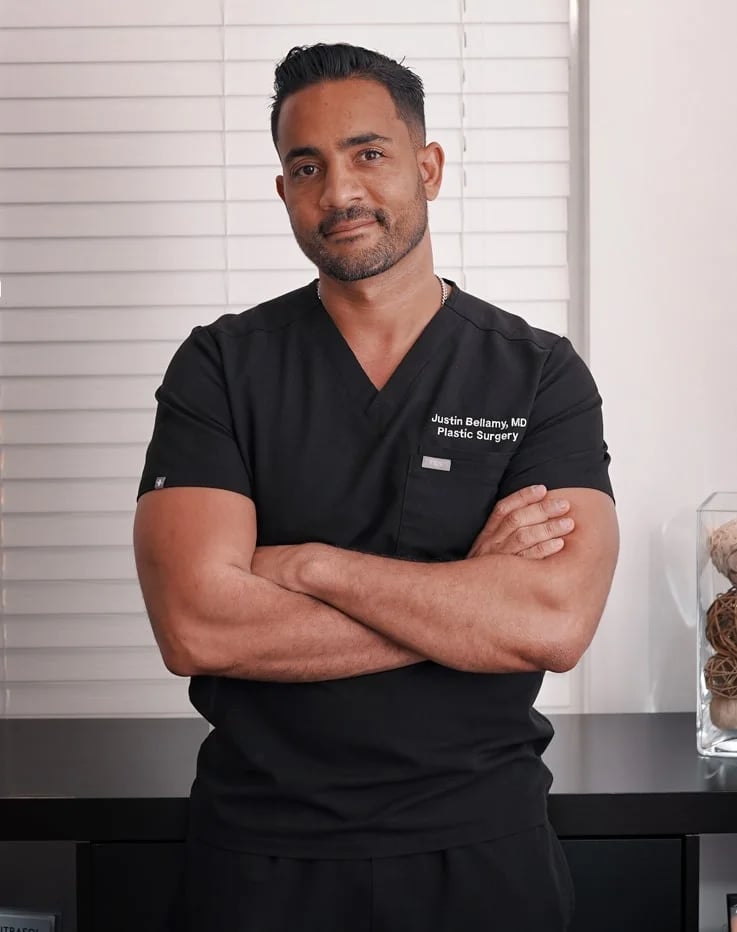
Dr. Justin Bellamy, a board-certified plastic surgeon practicing in Palm Beach, trained at Yale University, the Johns Hopkins School of Medicine, and the NYU Langone Plastic Surgery Residency program before completing an advanced fellowship in aesthetic surgery at the Dallas Plastic Surgery Institute. He has published more than thirty peer-reviewed articles and book chapters in plastic surgery and is known among patients for a transparency-driven approach, regularly sharing real patient outcomes, including his more conservative, smaller-volume cases, so prospective patients can see exactly what a subtle result looks like before committing to a surgical plan.
What 'Natural and Subtle' Actually Means in Practice
A truly subtle breast augmentation is not simply a smaller version of a dramatic one. It requires different planning decisions at nearly every stage: implant size and profile, incision and pocket placement, and the surgeon's approach to matching the result to the patient's existing chest width and tissue thickness. A small implant placed without attention to these details can still look obviously augmented if the profile is too round or the size does not proportionally match the patient's frame.
Many patients seeking this kind of result are specifically researching small breast augmentation as its own category, rather than simply asking for 'the smallest implant available,' because the goal is a specific look, not just a specific size.
Implant Selection for a Subtle Result
Implant profile, which refers to how far the implant projects forward from the chest wall relative to its width, matters as much as overall volume when the goal is a natural appearance. Lower and moderate profile implants tend to distribute volume more broadly across the chest, which generally reads as softer and more proportional, particularly in patients with a wider chest wall. Higher profile implants concentrate volume more centrally, which can create a rounder, more projected look that is harder to keep subtle even at a smaller overall size.
Silicone implants are generally preferred for a soft, natural feel and are less likely to show rippling compared to saline, which can be a meaningful consideration for thinner patients with less natural tissue coverage. That said, saline implants remain a reasonable option for some patients and the choice ultimately depends on individual anatomy and preference.
Sizing conversations for subtle augmentation often benefit from sizing exercises during consultation, where a patient tries on different implant sizers under clothing to get a realistic sense of how a given volume will actually look and feel, rather than relying purely on cubic centimeter measurements, which do not translate intuitively to visual outcome for most patients.

Placement and Incision Decisions
Pocket placement, meaning whether the implant sits above or below the chest muscle, affects both the immediate appearance and the long-term look of a subtle augmentation. Submuscular placement (under the muscle) tends to create a softer, more gradual slope at the top of the breast, which many surgeons consider more natural-looking for smaller implants, particularly in patients with limited existing breast tissue.
Patients interested in a placement approach that avoids general anesthesia and shortens recovery time may also want to ask about awake breast augmentation, which some practices offer as an option using local anesthesia with sedation rather than general anesthesia. This approach is not appropriate for every patient or every surgical plan, but it is a reasonable question to raise for patients specifically focused on a smaller, more conservative procedure.
Correcting Asymmetry Without Overcorrecting
A significant portion of patients seeking small breast augmentation are not primarily motivated by overall size, but by asymmetry, where one breast is noticeably smaller or shaped differently than the other. In these cases, the surgical goal is closer matching between the two sides rather than uniform enlargement, which sometimes means using two slightly different implant sizes, one for each side, to achieve visual balance.
This kind of case requires particularly careful preoperative measurement and planning, since the goal is symmetry rather than a specific target size, and overcorrecting one side can simply shift the visible imbalance in the opposite direction rather than resolving it.
Setting Realistic Expectations for Recovery and Results
Recovery from a smaller-volume augmentation is generally comparable to any implant-based breast surgery in its early stages, with swelling, tenderness, and restricted upper body activity for the first one to two weeks. Because the implants are smaller, some patients report a somewhat easier initial recovery in terms of tightness and pressure sensation, though this varies by individual.
It typically takes several weeks for implants to settle into their final position and for any initial swelling to resolve, meaning the earliest post-operative appearance is not the final result. Patients aiming for a subtle look sometimes worry in the first week or two that the change looks too dramatic, simply due to swelling, or conversely that it looks too minimal before the implants have fully settled. Both concerns typically resolve as healing progresses over the following one to two months.
Why Some Surgeons Recommend Against the Smallest Possible Implant
It might seem intuitive that the smallest available implant is automatically the most conservative and natural-looking choice, but experienced surgeons often push back gently on this assumption during consultation. An implant that is too small relative to a patient's chest width and existing tissue can sometimes create an unusual, slightly disproportionate look, particularly if the goal is a smooth, gradual transition between the chest wall and the augmented breast. In some cases, a slightly larger implant, paired with careful attention to profile and placement, achieves a more genuinely natural and proportional result than the absolute smallest option available.
This is part of why sizing conversations benefit from an in-person, hands-on approach rather than a patient arriving with a predetermined cubic centimeter number in mind based on online research. Surgeons who specialize in this kind of subtle augmentation typically spend meaningful consultation time helping patients understand how a given implant size and profile will actually look on their specific chest shape and width, since the same implant volume can look meaningfully different from one patient's anatomy to another.
Patients should feel comfortable pushing back if they feel a recommended size is larger than what they had in mind, and a good surgeon will be able to explain clearly why they are recommending a particular size and profile rather than simply defaulting to a standard recommendation. This kind of back-and-forth conversation, rather than a one-directional recommendation, tends to produce results that patients are genuinely happy with over the long term.
Dr. Bellamy has described his own consultation approach as deliberately collaborative rather than prescriptive, noting that his goal is to help each patient establish personalized goals and then build a customized surgical plan around those specific goals, rather than steering patients toward whichever size or approach he might personally favor in the abstract. For patients pursuing a subtle result, this kind of surgeon-led but patient-centered dialogue tends to matter more than it does for larger, more standardized augmentations, simply because there is more room for miscommunication about what 'subtle' actually looks like on a specific body.

The Importance of Chest Wall and Tissue Assessment
A surgeon planning a subtle breast augmentation will typically spend significant time during the physical exam assessing several specific measurements: the width of the chest wall, the distance between the nipple and the inframammary fold, the thickness and elasticity of existing breast tissue, and any pre-existing asymmetry between the two sides. These measurements are not just administrative data points; they directly inform which implant size, profile, and placement will actually achieve a proportional, natural-looking result on that specific patient's body.
Patients with less natural breast tissue coverage, sometimes described as having thin soft tissue, are generally better candidates for submuscular placement and moderate rather than high profile implants, since additional muscle coverage helps disguise the edges of the implant and reduce the visibility of rippling. Patients with more natural tissue coverage have somewhat more flexibility in their options, since the existing tissue itself provides some camouflage regardless of implant placement.
This kind of individualized anatomical assessment is a meaningful part of why generic advice about 'the best implant for a natural look' does not translate cleanly across different patients. What produces a subtle, proportional result for one patient's chest width and tissue thickness may look noticeably different, and potentially less natural, on a patient with a different starting anatomy, even using the exact same implant size and type.
Managing Expectations Around Clothing and Activity After Surgery
Patients pursuing a small, subtle augmentation are sometimes surprised by how much the recovery restrictions resemble those of any implant-based breast surgery, regardless of the modest size change involved. Most surgeons recommend avoiding underwire bras for several weeks after surgery, in favor of a supportive surgical or sports bra that does not place pressure on the healing incision or the settling implant. Upper body exercise, particularly anything involving pushing, pulling, or heavy lifting with the arms and chest, is typically restricted for a period of four to six weeks, with a gradual return to full activity guided by the surgeon's specific recovery protocol.
Patients should also expect some initial firmness and a higher-riding position of the breasts in the first few weeks after surgery, which is a normal part of the implant settling process rather than a sign that the final result will look unnatural. This can be particularly disorienting for patients specifically seeking a subtle result, since the early post-operative appearance can look more noticeable or higher than the eventual settled position. Patience during this settling period, along with realistic expectations set clearly during the pre-operative consultation, generally prevents unnecessary anxiety during the early weeks of recovery.
How to Communicate 'Subtle' Effectively in Consultation
One of the more common frustrations patients report from breast augmentation consultations, particularly when the goal is a modest result, is a feeling of not being fully heard, with the conversation gravitating toward larger sizes than what the patient actually wants. Part of this can be addressed by patients coming prepared with specific, concrete reference points rather than general descriptors alone. Bringing photos of breast shapes and sizes that reflect the desired outcome, ideally on a body type reasonably similar to the patient's own, gives a surgeon a much clearer target than a verbal description like 'just a little bigger.'
It is also useful to be specific about what 'natural' means personally, since this word means different things to different patients. Some patients primarily want to avoid any visible sign of augmentation, prioritizing subtlety in clothing and in intimate settings equally. Others are comfortable with clothing looking a bit different than before but want to avoid an overtly round, obviously enhanced upper pole. Still others are focused mainly on symmetry correction and are less concerned about overall size change. Clarifying which of these priorities matters most helps a surgeon translate a patient's goals into specific technical decisions about implant size, profile, and placement.
Patients should also feel free to ask a surgeon directly what they believe an appropriately natural result would look like for that specific patient's body, essentially inviting the surgeon's professional judgment into the conversation rather than treating the consultation purely as a request-and-fulfill transaction. Surgeons who specialize in this kind of subtle work often have strong, well-reasoned opinions about what will and will not achieve a natural look on a given patient's frame, and these opinions are worth hearing out even when they differ from a patient's initial assumptions.
Revisiting the Decision Months Later: What Patients Typically Report
Patients who undergo a carefully planned, conservative breast augmentation tend to report high satisfaction specifically because the result matches their original intention rather than exceeding it in a way they did not want. This is a meaningfully different pattern of satisfaction compared to patients who chose a larger size and later feel it draws more attention than they anticipated, which is one of the more common sources of post-surgical regret in breast augmentation generally.
Because subtlety is, by definition, a less dramatic transformation, it is worth setting expectations that the emotional experience of a small augmentation may feel less immediately gratifying in the first days after surgery compared to a more dramatic size increase, simply because the visible change is less pronounced. Patients who understand this ahead of time tend to feel more settled with their choice during the early recovery period, rather than second-guessing whether they should have gone larger simply because the change feels less immediately visible.
Ultimately, the patients who report the highest long-term satisfaction with a small, natural augmentation are typically those who went into the process with a clear, specific vision, communicated that vision effectively during consultation, and chose a surgeon willing to plan carefully around achieving that specific outcome rather than defaulting to a more generically popular size and shape.
Selecting a Surgeon Who Actually Specializes in Subtle Results
Not every plastic surgeon approaches breast augmentation consultations with the same philosophy, and patients specifically seeking a small, natural result are often better served by seeking out a surgeon whose portfolio and communication style reflect genuine experience with this specific goal, rather than assuming any board-certified plastic surgeon will naturally default to a conservative approach. Reviewing a surgeon's before-and-after gallery with an eye specifically toward their smaller-volume cases, rather than their most dramatic transformations, gives a much better sense of how that particular surgeon handles the kind of subtle, proportional work being sought.
During consultation, it is reasonable to ask a surgeon directly how often they perform augmentations in the size range being considered, and to ask to see specific examples of results in that range on patients with a similar starting chest size and shape. A surgeon who has extensive experience with dramatic augmentations but relatively little experience with smaller, more conservative cases may still be a highly skilled surgeon overall, but may not be the ideal fit for a patient whose specific goal is subtlety, simply because the technical considerations and aesthetic judgment calls involved in achieving a convincingly natural, modest result differ somewhat from those involved in larger augmentations.
Ultimately, board certification in plastic surgery, a track record of safe outcomes, and clear, patient-centered communication remain the foundational requirements for any surgeon performing this kind of procedure. Layered on top of those baseline requirements, specific experience and demonstrated skill with smaller, more understated augmentations is a meaningful additional factor worth prioritizing for patients whose goal is a result that reads as genuinely natural rather than obviously enhanced.
A Final Note on Confidence Versus Concealment
It is worth naming directly that wanting a subtle, undetectable augmentation is not the same thing as wanting to hide having had surgery out of shame, though the two motivations can sometimes get conflated in casual conversation. Many patients pursuing a small, natural result are entirely open about having had breast augmentation; their goal is simply an aesthetic preference for a look that blends naturally with their existing proportions, rather than a dramatic visual transformation. Other patients do prefer discretion about the procedure itself, and that preference is equally valid and worth respecting throughout the consultation and surgical planning process.
Whatever the underlying motivation, the technical goal remains the same: a result that looks proportional, feels natural in daily movement and clothing, and reflects a considered, well-planned surgical approach rather than a generic, one-size-fits-all outcome. Patients who take the time to clarify their own priorities, communicate them clearly, and choose a surgeon experienced in this specific kind of conservative, detail-oriented work tend to be the ones who look back on the decision with lasting satisfaction, years after the initial recovery period is a distant memory.
Frequently Asked Questions
What implant type looks most natural for a small breast augmentation?
Lower or moderate profile silicone implants tend to distribute volume more broadly across the chest, which generally creates a softer, more proportional look than higher profile implants, particularly for patients seeking a subtle result.
Should implants be placed above or below the muscle for a natural look?
Submuscular placement, under the chest muscle, often creates a softer slope at the top of the breast and is commonly recommended for smaller implants, especially in patients with limited existing breast tissue.
Can breast augmentation correct asymmetry without making the breasts look overly large?
Yes. Asymmetry correction often uses two different implant sizes, one per side, with the goal of visual balance rather than uniform enlargement, and this can be achieved with modest implant volumes.
How long does it take for a small breast augmentation to reach its final look?
Most initial swelling resolves within a few weeks, with implants settling into their final position and shape over the following one to two months.
Is awake breast augmentation an option for smaller implants?
Some practices offer awake breast augmentation using local anesthesia with sedation as an alternative to general anesthesia. It is not appropriate for every surgical plan, but it is a reasonable option to discuss for patients pursuing a smaller, more conservative procedure.
Discuss a Subtle Breast Augmentation in Palm Beach
If a modest, believable change is your goal, schedule a consultation at Bellamy Plastic Surgery to plan implant size, profile and placement around that result. Call (561) 705-0044 or complete our online contact form.