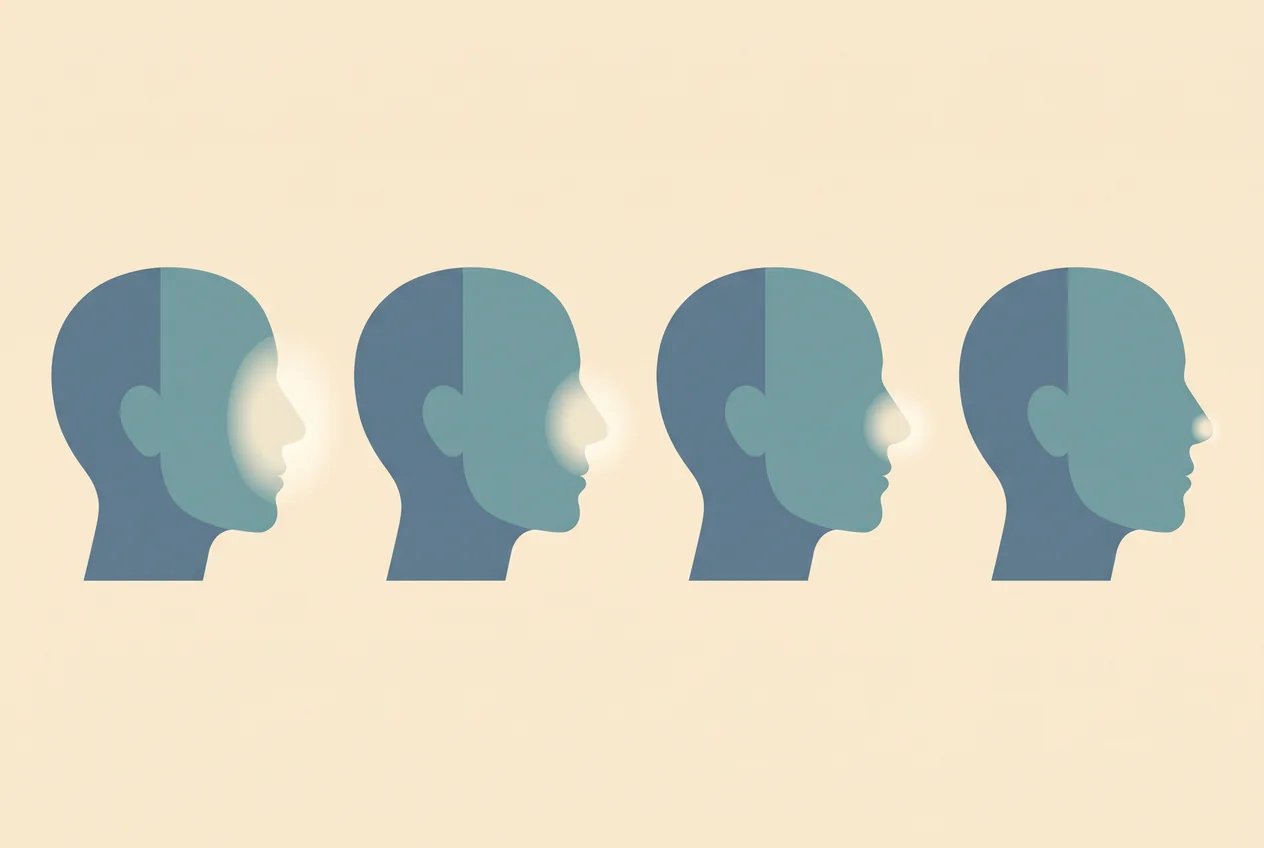
Almost every rhinoplasty patient asks the same question at the same moment, usually around day four or five, when the bruising is at its worst and the nose in the mirror looks nothing like the one they pictured: when does it look finished? The honest answer has two parts, and neither fits on a calendar invite. A nose looks presentable in public much sooner than most people expect, often within a couple of weeks. And a nose is truly finished much later than most people hope, because the last traces of swelling, particularly at the tip, can take the better part of a year or longer to disappear.
This guide walks through that timeline in the order it unfolds, from the first night through the second year. It explains what is actually happening under the skin at each stage, which changes are swelling and which are the result, why the tip is the slowest part to settle, and how factors like skin thickness, technique and revision surgery change the schedule. The aim is not to hand you a rigid set of dates, because healing varies, but to give you a realistic map so that a puffy week or a lopsided month does not feel like a verdict on the surgery.
Why the nose swells for so long
Swelling after surgery is the body’s repair crew arriving. Blood vessels leak a little fluid into the surrounding tissue, white cells arrive to clear debris, and lymphatic channels slowly drain the excess. In most parts of the body this finishes within weeks. The nose is different for a few anatomical reasons that explain why its timeline is so long.
First, the nose is built of tightly fitted layers: skin, a thin layer of fat and muscle, cartilage and bone. When the framework is reshaped, the skin has to shrink back and re-drape over a new structure. That re-draping is gradual, and until it finishes, any fluid trapped under the skin continues to blur the shape. Second, lymphatic drainage in the nasal tip is relatively sluggish. The tip has little room for fluid to spread, and its skin is often thicker and more tethered than the skin over the bridge. Third, scar tissue forms inside the nose as part of normal healing, and it matures over many months. Early on it is bulky and firm; later it softens and thins.
The result is a very particular pattern. The bridge and the sides of the nose tend to settle first. The area just above the tip follows. The tip itself, and the point where the tip meets the lip, tend to hold swelling longest. A patient can have a beautifully straight bridge at three months and still feel that the tip looks round, a little full or slightly upturned. That is not a failed result. It is the expected sequence.

The first twenty four hours and the first week
Right after surgery, the nose is supported by an external splint and often by soft internal splints or packing, depending on the technique and the surgeon’s preference. Expect a feeling of pressure and congestion, mild to moderate discomfort that is usually well controlled with prescribed medication, and some oozing of blood-tinged fluid in the first day. Breathing through the mouth is normal. Sleeping with the head elevated reduces swelling and is usually advised for the first week or two.
Swelling climbs over the first two to three days, and for many patients it peaks around day three. Bruising often spreads under the eyes and sometimes onto the cheeks, and its color changes from purple to green to yellow as the blood is reabsorbed. Eyelid puffiness can be dramatic in the first few days and is usually worse in the morning. Cold compresses applied around the eyes and cheeks, never directly on the nose, can be soothing if your surgeon allows them.
By the end of the first week the splint is commonly removed at a follow-up visit. This is a moment of anticipation and, often, disappointment. The nose underneath looks wider and rounder than the final result and may have visible bruising and dried skin. Many patients are startled. The nose is swollen in every direction, and much of what you see is edema, not shape. This is also the first time many people feel relief, because breathing starts to open up slightly and the heavy cast is gone.
For patients considering preservation techniques, it is worth knowing that surgeons describe these approaches as working with the existing structure of the nasal bridge rather than removing and rebuilding it. Many describe a gentler early recovery as a possible benefit, though every nose heals individually, and the practice’s pages on preservation rhinoplasty and on why Palm Beach patients choose preservation rhinoplasty explain the approach in more detail. No technique eliminates swelling, and anyone who promises that is overselling.
Weeks two through four: presentable, not final
By the second week, the worst of the bruising is fading. Yellowish residue may linger under the eyes, and it can be camouflaged with makeup once the surgeon says the skin is ready. Many patients feel comfortable returning to work, especially in jobs that involve little physical activity, somewhere between one and two weeks, though some prefer to wait longer and some surgeries or professions require it.
What you see in the mirror at this stage is a nose that is clearly different but still soft and thick. The bridge may look wider than expected, and the tip often looks swollen and slightly upturned. Both are partly the result of fluid and partly the result of normal tightness in the skin and the supporting tissues. A common experience is that the nose looks better on some days than others. Morning puffiness, salty meals, alcohol, a hot shower or lying flat for a long time can all make the nose look larger. That daily variation is a reliable sign of swelling and not of structural change.
Around this stage, numbness is common. The tip and the upper lip can feel dull or tingly, sensation returns gradually over weeks to months. Some patients notice a sense of tightness or stiffness when smiling or when pressing the tip. All of this is part of nerve and tissue recovery and is expected.
The activity restrictions matter here. The nose is still vulnerable, and the bones, if they were adjusted, are healing. Contact sports, anything that risks an elbow or a ball to the face, and heavy lifting or straining are usually restricted for several weeks to avoid raising blood pressure in the head and to protect the repair. Sunglasses and glasses may need to be kept off the bridge or supported in a specific way for a period, as the surgeon directs. Following those instructions is more important than any trick for reducing swelling.
Months two and three: the quiet middle
This is the stage that surprises patients, because very little appears to be happening. The dramatic changes of the first month are over, and the improvements are now subtle. Most of the visible swelling from the bridge and sides has resolved by about three months. A good number of patients feel they look “mostly there” and receive compliments from people who did not know about the surgery.
Yet the tip often remains fuller and less defined than expected, and it can feel firm or slightly hard to the touch. The area where the tip meets the bridge can look like a small step or a rounded shoulder. This is normal scar maturation. Patients with thick, oily skin may notice that the tip looks blunter for longer, because thicker skin shrinks and drapes more slowly over the refined structure underneath.
Photographs are helpful at this stage. Taking the same set of images from the front, side and angle in consistent light every month or so gives you a more accurate view of progress than the mirror, which you inspect daily and which therefore feels static. It is common to compare month three with month two and feel nothing has changed, then compare month six with month three and see a clear difference.
At around this time, most surgeons are comfortable with a return to full activity, including exercise and sports with caution around impact. Wearing a sun hat and high-factor sunscreen on the nose matters, because sun exposure can darken healing skin and make swelling linger. In Palm Beach, where year-round sun and humidity are part of daily life, that advice is more than a footnote.
Months four through six: the tip begins to refine
Between four and six months, most patients notice the tip becoming more defined and the overall nose looking more balanced. The soft, rounded edges of the early months give way to cleaner lines, particularly in profile. Skin that felt thick and tight becomes more supple. Numbness largely resolves for most people, though a small area at the tip may stay slightly altered longer.
This is also when patients and surgeons begin to see the pattern of the final result. If something is going to need attention, such as a small asymmetry or a tip that is persistently fuller than planned, it often becomes clear in this window. A thoughtful surgeon will usually advise waiting before any revision, because what looks like an issue at four months can fade by ten. For some situations, targeted treatments such as a diluted steroid injection to reduce firm tip swelling are used by some surgeons, and this is something to discuss with your own surgeon, not to seek out elsewhere.
Breathing, which may have improved quickly or taken weeks, generally stabilizes at this stage. If you still feel blocked on one side, mention it at your follow-up. Swelling inside the nose lasts a long time, and the sensation of congestion can persist even when the outside looks settled.
Months seven through twelve: the long tail
The second half of the first year is the long tail of swelling. By nine months many patients feel that the nose looks natural and settled, and others around them stop noticing anything unusual. But careful observers, including the patients themselves, can still find slight differences in morning versus evening, after exercise, or in heat and humidity. The tip may still continue to thin and rotate very slightly. These changes are so gradual that they are best measured by comparing photographs six months apart.
By twelve months the great majority of swelling has resolved, and this is the point at which surgeons typically describe the result as established. Some residual fullness, especially in the tip of people with thicker skin, can persist into the second year. Patients who have had revision surgery often take longer than those who have had a first operation, because scar tissue is more extensive and the blood supply is more limited. The practice’s information about revision rhinoplasty explains why those timelines run longer and why patience is more important than ever.
If the final result is ever going to be judged, twelve months is a reasonable time to do so, and some surgeons wait eighteen months before considering a revision. Having a plan for that conversation, and the confidence that your surgeon will not rush you, is part of choosing the right surgeon. The five tips for choosing a Florida rhinoplasty surgeon cover how to evaluate that kind of judgment before you commit.
A quick reference by milestone
| Milestone | What you will typically see | What is going on |
|---|---|---|
| Days 1 to 3 | Peak swelling, bruising around eyes, congestion | Fluid and blood collecting in tissue |
| Day 7 to 10 | Splint off, nose looks wide and soft | Skin still swollen, bruising fading |
| Weeks 2 to 4 | Presentable, bridge improving, tip puffy | Surface swelling draining, deeper swelling remains |
| Months 2 to 3 | Most bridge swelling gone, tip full | Scar tissue firm, skin re-draping slowly |
| Months 4 to 6 | Tip defining, profile cleaner | Scar tissue softening |
| Months 7 to 12 | Subtle refinement, daily variation fades | Fine residual swelling resolving |
| Beyond 12 months | Final result, minor tip changes continue | Skin and scar fully mature |
This table is a general guide. Individual timelines can run faster or slower, and your surgeon’s description of your own healing is the more important reference.
Three worries that are usually just swelling, and one that is not
Patients tend to fixate on a handful of things in the first months, and most of them have a simple explanation. The first is the upturned, short-looking tip. In the early weeks the tip is swollen and the skin is tight over it, which makes the nose look shorter and more rotated than the plan. As the swelling resolves, the tip settles down and lengthens slightly, and the profile you discussed at your consultation emerges. The practice’s rhinoplasty page explains the goals of tip refinement and rotation, and it helps to keep those goals in mind while the swelling hides them.
The second is the sense that the nose is crooked or uneven. Swelling is almost never symmetrical, because one side drains faster than the other, you probably sleep on one side more, and the natural asymmetry of your face is more visible against a puffy nose. Check photographs, not the mirror, and give it time. The third is a bump or fullness in the area just above the tip. This supratip fullness is a classic feature of the first year, caused by swelling and by early scar tissue in a space with little room to drain. It usually flattens over several months.
The one worry that deserves a real conversation is a change that appears after the first few months and keeps progressing, for example a bridge that looks lopsided or a tip that appears to droop or pinch, or breathing that gets worse instead of better. Those patterns are less likely to be simple swelling and more likely to reflect structural healing, so they are worth showing to your surgeon promptly. Even then, the standard advice is calm: most issues can be assessed in person at a follow-up visit, and the cases that need revision are handled when the tissue is ready, not in a panic.
What speeds up or slows down the timeline
Several factors push the schedule one way or the other, and knowing them can calm a lot of worry. Skin thickness is the biggest. Thin skin shrinks tightly over the new framework and shows detail early, but it also reveals every irregularity. Thick, oily skin hides small imperfections but swells longer and drapes more slowly, so the tip often takes the full year or more to define. Many patients in South Florida with thicker skin or with strong, wide nasal features fall into this group, and the discussion of how nasal cartilage differs between patients explains why one technique does not suit every nose.
Technique matters, though less than people assume. Open and closed approaches both produce long-term swelling at the tip, with the open approach often associated with somewhat more tip swelling because of the incision across the columella. The tradeoffs between the two are covered in the practice’s comparison of closed versus open rhinoplasty. Preservation techniques are often described as more conservative to the structure of the bridge, and scarless rhinoplasty refers to the closed preservation approach that avoids an external incision. Neither promises a swelling-free recovery.
Revision surgery tends to run longer, since previously operated tissue has less blood supply and more scar. Patients who have had a prior nasal injury or multiple procedures should expect an extended timeline. Hispanic rhinoplasty and other cases that involve strong, thick cartilage or skin can behave similarly, because the goal is to refine without erasing the character of the nose, and the soft tissue envelope needs more time to adapt.
Age, health and habits count too. Younger patients heal faster in general, and smokers heal slower with a higher risk of complications. Adequate sleep, a diet low in salt, avoiding alcohol in the early weeks, and staying out of the heat help control swelling. Medications and supplements that increase bruising, such as aspirin, certain anti-inflammatories and some herbal products, are usually stopped before surgery on your surgeon’s instructions.
Men, women and teens: small differences worth knowing
Healing patterns differ a little between groups, mostly because of skin and anatomy. Male noses tend to have thicker, oilier skin and larger structures, and a male rhinoplasty often preserves strength and a natural profile rather than creating dramatic refinement. The practical effect is that the tip may hold swelling for longer, and the result is subtle and natural when done well. Female rhinoplasty frequently aims for refinement of the tip and a gentle rotation, with thinner skin in many patients, which shows detail earlier.
Teenagers are a special case. Nasal growth must be complete before surgery in most cases, and the discussion of teenage rhinoplasty covers readiness, timing and expectations. Younger skin is often elastic and heals quickly, and teens may see their final outline earlier than adults, although the emotional work of adjusting to a new face deserves attention too.
Habits that make a real difference
Most of what helps is unglamorous. Keep your head elevated, including on the couch and during naps, for the first couple of weeks. Walk gently each day to support circulation without raising blood pressure. Eat lightly salted food and stay hydrated, because salt drives fluid retention. Avoid alcohol and tobacco, both of which interfere with healing. Do not blow your nose in the early weeks, and sneeze with your mouth open if you must. Protect the nose from the sun with a hat and, once cleared, with sunscreen. Keep glasses off the bridge as directed.
Equally important is what not to do. Do not press, massage or tape your nose on your own unless your surgeon has told you to. Do not search forums for the swelling schedule of a stranger and compare yourself to it. Do not judge your result on a bad morning. Do not accept injections or treatments from anyone other than your surgeon in the first year without consulting them. And do not schedule a major photograph, a wedding or a speaking event in the first few months and expect to be finished.
When to call the office
Most worries in recovery are normal. Some are not. Contact your surgeon promptly if you have bleeding that soaks through dressings or does not slow with the measures you were given, fever, severe pain that is not controlled by your medication or that suddenly worsens, redness and warmth spreading across the nose or cheeks, pus or foul-smelling drainage, a sudden change in nasal shape after an injury, new difficulty breathing, vision changes, or severe headache. These are uncommon, but they are worth a phone call, even at night.
Questions that feel minor deserve answers too. Asymmetry in the first month, a bump that seems to appear, a nose that looks crooked in the morning, and a tip that feels hard are all common concerns, and a surgeon who invites those questions is a surgeon who knows what patients go through. Dr. Justin Bellamy publishes patient outcomes on social media, and the rhinoplasty photo gallery shows results, though photographs are no substitute for a consultation about your own anatomy.
Reading before and after photographs with the timeline in mind
When you look at before and after photographs, ask when the after photograph was taken. A nose photographed at three weeks looks very different from the same nose at twelve months, and a gallery that does not say which is shown can mislead. Look for consistent angles and lighting, a range of noses that resembles yours, and a mix of timeframes. Ask whether the photographs show results at one year or later.
Also remember that a profile photograph can hide the other half of the story. A nose that looks balanced from the side can appear different from the front, and the relationship of the nose to the chin matters. Sometimes the profile is improved most by looking at the whole face, and a conversation about whether a chin implant would improve balance is part of a thorough consultation. That is not an upsell. It is how a surgeon thinks about facial harmony.
Choosing a surgeon who talks about healing honestly
A surgeon who gives you an honest healing timeline, including the long tail, is telling you something about how they practice. Be cautious of anyone who promises that you will look perfect in a month or who dismisses concerns about tip swelling. Ask how many follow-up visits are included, how the office handles questions between visits, and what happens if the result needs refining. Ask to see photographs of patients at one year whose noses resemble yours.
At Dr. Bellamy’s practice in Palm Beach Gardens, rhinoplasty is one of the procedures he focuses on, and his training includes a plastic surgery residency at NYU Langone and an aesthetic plastic surgery fellowship at the Dallas Plastic Surgery Institute. You can learn more about Dr. Justin Bellamy, read patient testimonials, and contact the office with questions about your own timeline. A consultation is the place to translate this general map into a specific one, based on your skin, your anatomy and your goals.
Frequently Asked Questions
How long does swelling last after rhinoplasty?
Most visible swelling resolves over the first three to six months, but subtle swelling, especially at the nasal tip, can continue for twelve months or longer. Thicker skin and revision surgery tend to take longer. Your result is generally considered established at about one year.
When can I go back to work after rhinoplasty?
Many patients return to desk-based work within one to two weeks, once the splint is off and the worst bruising has faded. Physically demanding jobs and public-facing roles may require more time. Your surgeon will advise based on your procedure and healing.
Why is my nasal tip still swollen after three months?
The tip has thicker skin, less room for fluid to spread and slower lymphatic drainage than the bridge. Scar tissue inside the tip also matures slowly. Persistent tip fullness at three months is common and usually improves over the following months.
When will I be able to see my final rhinoplasty result?
Most of the shape is visible by three to six months, but the final refinement, especially of the tip, typically takes about twelve months. In thick-skinned noses and revision cases it can take up to eighteen months or more.
Is it normal for my nose to look different from day to day?
Yes. Swelling fluctuates with sleep, salt, heat, alcohol, exercise and time of day, and mornings are often worse. These fluctuations usually decrease over the months and do not indicate a change in the underlying result.
Does preservation rhinoplasty heal faster?
Some surgeons find preservation techniques gentler on the bridge, which may be associated with a more comfortable early recovery, but individual healing varies and the tip still swells for months. No technique guarantees a faster or swelling-free recovery.
When can I exercise after a nose job?
Light walking is usually encouraged early. Strenuous exercise and anything that raises blood pressure is often delayed for a few weeks, and contact sports for longer. Your surgeon will give specific timing for your case.
When can I wear glasses or sunglasses after rhinoplasty?
Weight on the bridge can affect healing bones and tissues, so surgeons often advise keeping glasses off the nose or supporting them in a specific way for several weeks. Follow your surgeon’s instructions for your situation.
Will numbness in my nose go away?
Numbness at the tip and upper lip is common and usually improves gradually over weeks to months. A small area may stay slightly altered longer. Report numbness that is worsening or accompanied by other symptoms.
Can I get a steroid injection to reduce tip swelling?
Some surgeons use dilute steroid injections for persistent firm swelling in selected cases, but they carry risks and should only be considered by your own surgeon after assessing your healing. Do not seek this from an unrelated provider.
How should I sleep after rhinoplasty?
Sleep on your back with your head elevated for the first week or two, which reduces swelling and protects the nose from pressure. Avoid sleeping on your side or face until your surgeon says it is safe.
When should I worry about my recovery?
Call your surgeon for heavy bleeding, fever, severe or worsening pain, spreading redness, foul drainage, a sudden change in nasal shape after an injury, trouble breathing or vision changes. For anything that worries you, a phone call is always appropriate.
Plan Your Rhinoplasty Recovery With Dr. Bellamy
Your own healing timeline depends on your skin, your anatomy and the technique used. Contact Bellamy Plastic Surgery to request a consultation with Dr. Bellamy. Call (561) 705-0044 or complete our online contact form.