

If you are reading this, you may have been thinking about your implants for a while. Perhaps quietly. Perhaps at night, or in the shower, or while a friend was talking about something else entirely. Thinking about taking them out is more common than most people realize, and it does not mean you made a mistake when you had them put in. It usually means your life changed, or your body did, or you learned something new.
This guide is written for that person. It is meant to be read slowly, in the order you would actually go through the experience: the question, the appointment, the choices, the day itself and the weeks afterward. You can stop at any stage. You can come back. Nothing here needs to be decided today.
The first stage: the question
Most people who consider explant surgery start with one of a handful of reasons. Some are physical. The implants have hardened or shifted, or feel uncomfortable or look different from how they once did. Some are medical, such as a rupture found on imaging. Some are about health worries and a wish to feel at ease in one's body. Others are simply about taste, since a size chosen at twenty-five may not suit the person at forty-five. And some people cannot name a reason at all, and just know it is time.
All of these are legitimate. You do not need a dramatic story to ask a surgeon about removal.
It also helps to know one thing that surprises many people: breast implants are not designed to last a lifetime. The FDA says so directly, and the more you know about that, the less alarming it feels when a surgeon suggests replacing or removing them. The practice has written about how long implants last and what to expect as they age, in a piece that asks whether breast implants last forever.

A word about symptoms and worry
Some people who seek explant surgery describe a cluster of symptoms, like fatigue, joint pain, brain fog or rashes, and wonder whether their implants are the cause. It is worth being honest about where the science stands. The FDA has acknowledged that some patients report these symptoms, often called breast implant illness, and has said that the evidence available is not enough to establish that implants cause them. It has also said that many patients report feeling better after removal, and that it is a real experience for those who have it, even if the cause has not been proven.
That leaves you in a hard place, and a good surgeon will not brush it aside. A good surgeon will also not promise you that removal will fix the symptoms. The honest position is somewhere in between: your experience is real, no one can guarantee what removal will change, and it is sensible to have your symptoms looked at by your primary care physician too, since fatigue and joint pain have many possible causes.
If someone tells you with total certainty that your implants are or are not the problem, be a little cautious about the certainty.
The second stage: checking on what is inside
Before you decide anything about surgery, it can be useful to know what your implants are doing. If you have silicone gel implants, the FDA recommends imaging to screen for silent rupture. The usual advice is an ultrasound or MRI about five to six years after surgery, and then every two to three years after that. Saline implants that leak are usually obvious, because they deflate. Silicone implants can rupture without any change you can see or feel.
If you have never had imaging, or cannot remember when your implants were placed, that is a useful place to start. Bring whatever paperwork you have. The implant card from your original surgery, if you can find it, lists the manufacturer, size and type. If you cannot find it, the surgeon can still help, and the operative report from your original surgeon can be requested.
It is also worth knowing whether your implants are a type that has been recalled or has drawn safety notices. The card, or the surgeon who placed them, is the way to find out. Textured implants from certain manufacturers have been linked to a rare lymphoma of the immune system called breast implant associated anaplastic large cell lymphoma. It is uncommon. But if you have that kind of implant, or new swelling or fluid around an implant years after surgery, it is worth mentioning promptly instead of waiting.
The third stage: the appointment
When you book, mention that you are considering removal, not replacement. It is a small thing, and it helps the practice set aside the right amount of time.
At the visit itself, most surgeons will listen first. Expect to be asked how long you have had your implants, what kind you have, what prompted the question and what you want to look like afterward. Bring your imaging results if you have them, along with the implant card and a list of any symptoms, when they began and what you have tried.
Then comes the examination. The surgeon will look at your breast shape and skin, at how your implants sit and at what your tissue looks like underneath. A lot depends on this. It is what tells the surgeon whether your breasts will look natural after the implants come out, or whether other steps would help.
If you would like to talk with Dr. Bellamy about your situation, his practice is in Palm Beach Gardens, a short drive from West Palm Beach, and it can help to know who you will be meeting, since his training at Yale, Johns Hopkins and NYU Langone is laid out in his biography.
What breasts look like after implants come out
This is the question people are often afraid to ask, so here is a plain answer. It varies. Some women are pleased and surprised by how their breasts look. Some see a smaller, softer breast with a shape that matches their pre-implant proportions. Others see stretched skin, loss of fullness at the top, a lower nipple position or visible changes in the breast crease, because implants over time can stretch the skin and change the tissue around them.
What you look like afterward depends on several things: the size of your implants, how long you have had them, how much natural breast tissue you have, the quality and elasticity of your skin, whether you have had pregnancies or weight changes, and how much the tissue has adapted around the implant.
That is exactly why the surgeon's exam matters, and why you should ask for honest predictions. A surgeon who says "you'll look great" without examining you has told you nothing. A surgeon who describes several likely outcomes, and what could be done about each, has told you a lot.
The fourth stage: the choices
There is more than one way to approach an explant, and the right one is the one that fits your body and your goals.
Removal alone. The implants are taken out, and the pocket around them is addressed as needed. Some people choose this because they want the simplest operation and are comfortable with what their breasts will look like afterward.
Removal with a breast lift. When the skin has stretched, the nipples sit low or the breast looks deflated after implants come out, a lift can reposition the tissue and restore a more youthful shape. The practice's page on breast lift with or without implants describes how a lift works, and it is a common companion to explant surgery.
Removal with fat grafting. Some patients want some fullness back without an implant. Fat can be taken from another part of the body and placed in the breast to add soft volume. The amount that can be added is modest, and not all of the fat survives, so it is best thought of as a refinement. It is worth asking whether it makes sense for you.
Exchange. Some people decide to swap their implants for new ones, a different size or a different type, in the same operation. The practice's page on breast revision and implant removal covers exchange and the other ways an existing implant can be handled.
There is no ranking here. None of these is a better or worse decision. A person who is sure she does not want implants and a person who wants a smaller pair can both be right.
Capsules, and the question to ask
Over time, the body forms a layer of scar tissue around any implant, known as a capsule. In many people it stays thin and soft. In others it thickens or tightens, a condition called capsular contracture, which can make the breast feel firm, look distorted or become painful.
When implants are removed, the surgeon must decide what to do about the capsule. There are a few approaches. The capsule can be left in place, partly removed or removed in one piece, sometimes described as en bloc. The right choice depends on the condition of the capsule, whether there is a rupture, the type of implant and your own goals. En bloc removal is more involved, and it is not always necessary or possible.
Because approaches vary, this is an excellent question for your consultation: which capsule technique do you recommend for me, and why? A good answer describes the reasoning. If you have a specific concern, such as a ruptured silicone implant or a textured device, say so, and ask how it changes the plan.
It is also fair to ask what the pathology plan is for the removed tissue. Many surgeons send capsule tissue to a laboratory for examination, and it is reasonable to ask whether that is done and how the results are shared.
The fifth stage: how you will be cared for
Explant surgery is generally an outpatient operation, and Dr. Bellamy's practice performs surgery in its own accredited facility with two AAAASF-certified operating rooms. Ask which type of anesthesia will be used for your case, and what the options are. The practice offers awake surgery for some procedures, including breast augmentation, so it is fair to ask whether that is an option for you. Whether it suits an explant is a conversation to have with him, and not something to assume.
You should also ask who will be with you during and after the operation, what the plan for pain control is, and how you can reach the team after hours. These are ordinary questions, and worth asking any practice.
Getting ready, gently
The weeks before surgery are when small things help a lot.
If you smoke or vape, stopping well ahead of time improves blood flow and healing. Tell the surgeon about every medication and supplement you take, since some increase bleeding and need to be stopped. Get any medical clearance the practice asks for, and take care of the ordinary things: your family history, a recent mammogram if you are due for one, and any records you have from your original surgery.
Plan the house as well. You will want front-closing clothing, since lifting your arms may be uncomfortable. Set up a place to rest with pillows. Arrange help with the first day or two, especially if you have small children or pets. And be kind to yourself about the schedule: take more time off than you think you need.
Mentally, too, prepare for two things. First, that the immediate look after surgery is not the final look. There will be swelling, bruising and a bandaged, sometimes flat-looking chest at first. Second, that you may feel a mix of relief and grief. Some people feel lighter right away. Some feel strange about seeing their body change. Both are normal.
The day itself
Surgery times vary, since the operation depends on whether you are having a lift, fat grafting or capsule work in addition to removal. Your surgeon will give you an estimate.
You will arrive, meet the team and go over the plan one more time. Before you go to sleep, or before the procedure begins if you are awake, say out loud any last worry. That is what those few minutes are for.
Afterward you will rest in recovery, be given instructions and go home with your companion. You will likely have a supportive garment or dressings, and possibly small drains in some cases. Ask ahead of time if drains are likely for you, since it is a common surprise.
The first few days
The first days are usually about rest, and about getting into a rhythm with medication and movement. Expect soreness, tightness across the chest and swelling. Sleeping on your back with your head raised is usually recommended. Short, gentle walks help circulation and are typically encouraged from the start.
Call the practice if you have swelling that is much greater on one side and increasing quickly, severe pain that is not controlled by your medication, fever, redness that is spreading, or any drainage that worries you. Your surgeon's list takes priority, but a good rule is that when you are unsure, a call is never wasted.
Weeks one to six
Recovery is different for everyone, and it depends on what was done. Removal alone is generally a lighter recovery than removal with a lift and other procedures. As a general framework, most people return to desk work within a week or two. Lifting, exercise and anything that strains the chest waits for several weeks, and your surgeon will tell you when.
You will wear a support garment for a period the surgeon specifies. Follow-up appointments check that your incisions are healing and that swelling and any fluid are settling. Do not skip them, even if you feel great.
Emotionally, this period can have some ups and downs. The swollen, unfamiliar breast shape on day five is not the result. Take photos, keep them private and compare them at week six instead of day six.
Months two to twelve: the settling
Breasts continue changing for months. Swelling resolves in stages, incisions fade and soften, and the tissue finds its final position. If you had a lift, the new shape settles down over several months. If you had fat grafting, the final volume becomes clear once the swelling is gone.
Scars are part of the picture. They begin pink and firm and gradually soften and fade over a year or more. Sun protection on scars matters, and your surgeon can advise you on care.
If your symptoms were one of the reasons for surgery, give yourself time before judging the outcome, and keep your primary care physician informed. Some people notice changes early. Some do not, and for some the symptoms turn out to have other causes that are worth investigating. It is fair to hope, and it is wise to keep the hope loose.
When something is not quite right
Occasionally the result is not what was hoped. There may be asymmetry, a fold or a contour that needs attention. There can be a fluid collection, a wound that heals slowly or a scar that needs care. Most of these can be managed, and the earlier you raise them, the easier they are to address.
If you have had a previous operation that left you unhappy and are considering a second opinion, that is a common reason people come in. The practice's broader overview of revision plastic surgery describes how a corrective operation is approached and what to bring.
Questions to bring to the appointment
It helps to write down your questions in advance, since it is easy to forget them in the room. A few worth including:
- What do you see in my breasts that tells you how they will look after the implants come out?
- Which capsule technique do you recommend for me, and why?
- Would you recommend a lift, and if so, at the same time or later?
- Is fat grafting realistic for me?
- What type of anesthesia do you suggest, and what is the alternative?
- What are the risks specific to my situation?
- What will recovery look like for the exact operation you are proposing?
- What is the cost, what does it include and what is not included?
- What happens if I am not happy with the result?
Notice that none of these is confrontational. They are the kind of questions a thoughtful patient asks, and a thoughtful surgeon welcomes.
Cost, in plain terms
The cost of explant surgery depends on what is done. Removal alone is generally less than removal with a lift or with fat grafting, and an operation involving capsule removal or a replacement implant is priced differently again. Most practices provide a written quote after an examination, since it is impossible to price accurately from a distance.
Ask what is included: the surgeon's fee, anesthesia, the facility, the garments and follow-up visits. Ask, too, whether there is any difference in cost if a plan changes on the day. Insurance rarely covers cosmetic explants, though coverage may exist in some medical situations, such as a rupture or a capsular problem. If that applies, ask the practice how it handles insurance, and check with your insurer.
Looking at photos with realistic eyes
Before-and-after photos can be helpful and, if you are not careful, misleading. When you look at breast surgery photos, remember that every body is different, that lighting and angles matter and that photos show one patient's outcome, not a promise. Look for patients whose starting point resembles yours, and look at how natural the results appear, how the scars have healed and how consistent the outcomes are across many patients instead of one dramatic case.
Ask, too, whether the photos you are seeing are of the surgeon's own patients, and how long after surgery they were taken. A photo at six weeks and one at one year tell different stories.
For people who feel unsure
You might not be ready. That is fine. Some people spend a year thinking about it, having imaging done and getting a second opinion before deciding. Others decide quickly. There is no wrong pace.
What is worth avoiding is deciding out of pressure: from a social media post, from a friend's certainty, from a deadline you set for yourself or from a practice that wants a deposit before you have had time to think. A good consultation leaves you with more clarity, not more urgency.
And if the answer turns out to be "keep them for now," that is a real answer too. Implants do not have to come out on a schedule, provided they are checked on and you feel well.
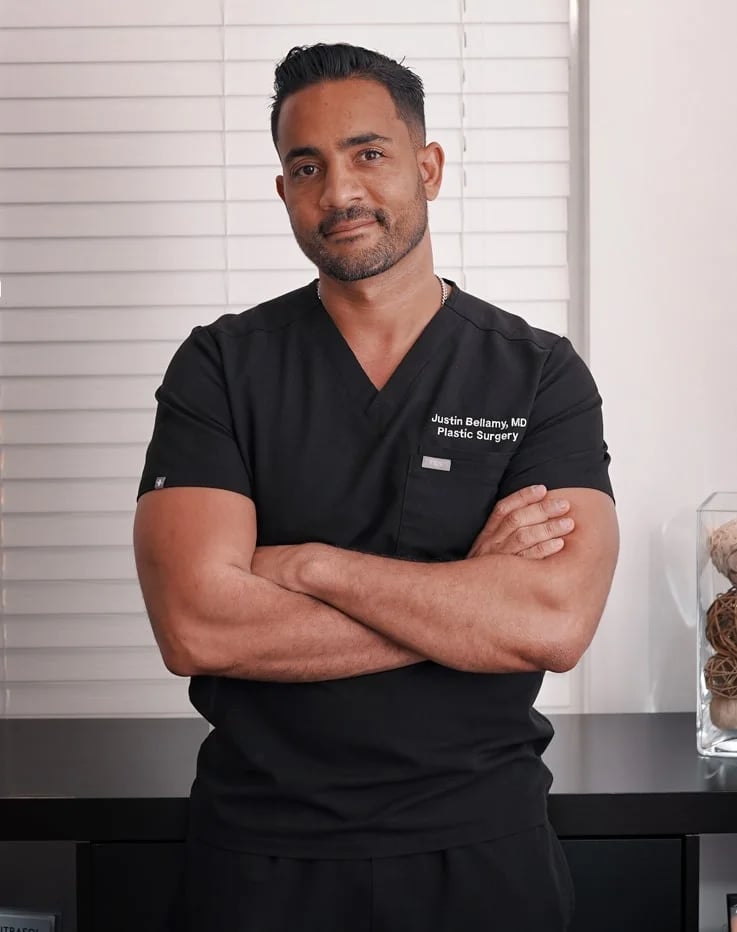
When you are ready
Whenever you are ready, the team at Dr. Bellamy's office can be reached at (561) 705-0044. If you would rather start in writing, a short message through the practice's contact form with a line about what you have been thinking, and how long you have had your implants, is enough. You do not need to have your decision made. Bringing the question is the first step, and it is a perfectly good place to begin.
Frequently Asked Questions
How do I find an explant doctor in West Palm Beach?
Look for a board-certified plastic surgeon who does breast revision and implant removal regularly, and ask how many explant operations they perform, which capsule techniques they use and what before-and-after results they can show. Dr. Bellamy's practice is in Palm Beach Gardens, a short drive from West Palm Beach, and you can call (561) 705-0044 to ask about a consultation.
How long does breast implant removal surgery take?
It varies by what is done. Removal alone is usually shorter than removal combined with a breast lift, fat grafting or capsule work. Your surgeon will estimate the time for your specific plan after examining you.
What will my breasts look like after the implants are removed?
It depends on your implant size, how long you have had them, your natural breast tissue and the elasticity of your skin. Some people are pleased with a soft, smaller shape, and others have stretched skin or a low nipple position that a lift can address. A surgeon can give you a realistic prediction after an exam.
Should I have a breast lift when my implants are removed?
Sometimes. If the skin is stretched or the nipples sit low, a lift can restore a more youthful shape, and it can be done at the same time as removal. If the tissue is in good condition, removal alone may be enough. Dr. Bellamy can advise you after examining you.
What is en bloc capsulectomy, and do I need it?
En bloc means removing the implant together with its surrounding scar tissue capsule in one piece. It is not always necessary or possible, and the right approach depends on the condition of the capsule, whether there is a rupture and the type of implant. Ask your surgeon which technique they recommend for you and why.
Will removing my implants cure breast implant illness symptoms?
No one can promise that. The FDA has said that some patients report symptoms such as fatigue and joint pain, that the evidence does not establish that implants cause them and that many patients report feeling better after removal. Have your symptoms evaluated by your primary care doctor too, since they have many possible causes.
How often should I have my implants checked?
For silicone gel implants, the FDA recommends imaging with ultrasound or MRI about five to six years after surgery and then every two to three years. Saline implants that leak usually deflate visibly. Ask your surgeon which schedule suits your implants.
How long is the recovery after explant surgery?
Many people return to desk work within one to two weeks, but it depends on what was done. Removal alone is usually a lighter recovery than removal with a lift and other procedures. Exercise and lifting wait several weeks, and your surgeon will tell you when.
Can I get new implants at the same time as removal?
Often yes. Some patients exchange their implants for a different size or type in the same operation. Whether that suits you depends on your tissue, your goals and the condition of the implant pocket, and a consultation is the best way to find out.
Is breast implant removal covered by insurance?
Usually not when it is done for cosmetic reasons. Coverage is sometimes possible in specific medical situations, such as a rupture or a capsular problem. Ask the practice how it handles insurance and check with your insurer before surgery.
Talk Through Breast Explant Surgery With Dr. Bellamy
Whether you are ready to plan or only want your implants checked, contact Bellamy Plastic Surgery to schedule a private consultation. Call (561) 705-0044 or complete our online contact form.