

You can learn a surprising amount about your own body in ten minutes, one mirror and a phone camera. Not everything. But enough to walk into a consultation knowing what question you are really asking, which is worth more than any brand name on a brochure.
The question, for a lot of people considering Lipo 360, is not "how do I get rid of fat?" It is quieter and more anxious: "if the fat goes, what will the skin do?" Nobody can promise an answer from a distance. You can, however, gather the evidence that points toward one, and that is what this guide is for. Set aside a quiet ten minutes, wear something you don't mind lifting, and work through it in order.
A ground rule first. These are screening tests, not diagnoses. They will not replace an exam, and they will occasionally mislead you. Their job is to sharpen your questions.
The three-part problem
Almost everyone who says "I want to fix my midsection" is dealing with some combination of three separate things:
- Fat, sitting in a layer under the skin.
- Skin, which may be stretched, thin or loose.
- Muscle and connective tissue, specifically the abdominal wall, which can be separated or slack after pregnancy or weight change.
Liposuction treats the first. It does not remove skin, and it does not tighten muscle. That is not a defect in the operation. It is just the division of labor, and the whole game is working out which of the three is your main problem. Your tests will tell you that.
Setting up
Stand in front of a full-length mirror in good, even light. Overhead lighting flatters no one, so use daylight or a lamp at chest height. Wear underwear or a bathing suit. Take photos as you go, from the front, both sides and the back, because photos show what you stop noticing in the mirror.
Do each test twice, once when you are relaxed and once when you are as relaxed as you can be after a meal, since your abdomen changes through the day. Write notes. You will forget details by the time you get to a consultation.
Test one: the pinch
Stand relaxed and pinch the skin and fat of your lower abdomen between your thumb and fingers, away from the muscle. Pull it gently away from the body.
What you are feeling for is thickness and quality. If you gather a thick, springy roll that feels full and firm, the problem is largely fat. If what you pick up is thin, papery or doughy, and it wrinkles like crepe or stays pinched when you let go, the problem is mostly skin.
Take note of how fast it snaps back when released. Elastic skin returns quickly. Skin that has lost its recoil returns slowly, or not entirely.
Do it in a few places: below the navel, above it, at the flanks and at the back. Skin quality often differs across the trunk, and a plan needs to account for that.
Test two: the lie-down
Lie on your back with your knees bent and let your abdomen relax. Now look down.
If the front of your abdomen flattens noticeably, the bulge you see standing is largely fat and loose tissue that falls forward with gravity. If it stays domed even lying flat, something deeper is contributing: either the abdominal wall is pushing outward, or there is fat inside the abdomen that liposuction cannot reach.
That second possibility matters. Fat is stored in two places: just beneath the skin, where liposuction works, and around the organs deeper inside, where it cannot. A firm, protruding belly that doesn't soften when you lie back suggests a large deep component, and liposuction will change it less than you hope.
Test three: the bend
Bend forward at the waist, letting your torso hang. Look at what your skin does.
Skin that folds or hangs in a fold, sometimes described as an apron, has more excess than it seems when you're standing. Notice whether the fold overhangs your underwear, and whether it hangs from below the navel or from the whole lower abdomen. A significant hang is a strong sign that skin, and not only fat, is part of the picture.
Test four: the lift
Stand upright and, with your palms flat, lift the skin of your lower abdomen upward and slightly back toward your ribs, as though you were tucking the tissue away.
Now look in the mirror. If your waist looks smooth and your silhouette improves dramatically, skin excess is doing much of the damage, and removing fat alone will not deliver that look. If lifting changes very little and the bulge remains, fat or muscle is the main driver.
It is a crude simulation of what a tummy tuck does, which is why it is one of the more informative tests here.
Test five: the head raise
This is the muscle check. Lie on your back with knees bent. Place your fingertips just above the navel, pointing toward your feet. Lift your head and shoulders slightly off the floor as if beginning a crunch, and feel along the midline.
A gap between the two halves of the rectus muscles, a ridge or a dome that pops out down the center as you lift, suggests diastasis recti, meaning separation of the abdominal wall. Many people count the gap in finger widths, and about two fingers or more is commonly described as significant, though the depth and firmness of the tissue matter more than the width alone.
Diastasis is not a fat problem, and no liposuction will repair it. It is worth naming because it is a big reason for the "I lost weight and still have a pouch" experience, especially after pregnancy.
Test six: the stretch mark map
Look at where any stretch marks are. Marks below the navel are usually within the skin that a tummy tuck removes. Marks above the navel are less likely to be removed, since that skin is repositioned instead of taken away, though their appearance can improve.
Also notice what they look like. Fine, silvery lines in otherwise firm skin are one story. Wide, crinkled, thin skin with marks running through it is another, and it signals lower elasticity.
Test seven: your history
Some evidence does not show up in a mirror. Answer these honestly:
- How old are you? Skin loses elasticity with age, but the relationship is loose. Fifty-year-olds with great skin exist, as do thirty-year-olds without it.
- Have you had children, and how many? Each pregnancy stretches the abdominal wall and skin, and the effect accumulates.
- What has your weight done? Slow, small changes are gentler on skin than a large gain and a rapid loss. A big weight loss, from diet, bariatric surgery or medication, often leaves skin behind.
- Do you smoke, or have you smoked? Smoking damages collagen and impairs healing.
- How much sun have you had? Sun damage degrades skin elasticity, and Florida is not gentle on it.
- What does your family look like? Skin quality is partly inherited. If your mother's skin held up well, yours may too.
- Have you had a C-section or abdominal surgery? Scars and scar tissue matter in planning. One example is a patient with two pregnancies and a C-section whose combined plan is shown in tummy tuck case 784, which reads differently once you know her history.
Five ways the tests can fool you
Self-assessment has traps, and it is better to know them going in.
Time of day. Most abdomens are flatter in the morning and rounder by evening. Test at the same time on two different days before deciding what your baseline is.
Your cycle. Bloating and fluid retention change the picture over a month. If the results look different from one week to the next, take the more conservative reading.
Posture. Arching your back or tightening your core changes everything. Stand the way you normally do, which is harder than it sounds.
The mirror. Mirrors flatter and flatten. A phone photo, taken from the same distance each time, is more honest, and so is a photo taken by someone else.
Wishful reading. People tend to see what they hope to see, in both directions. If you find yourself arguing with a result, take it as a sign to ask a surgeon to look, not to keep repeating the test until it says something different.
Adding it up
Now put your results together. Most people fall into one of four groups.
Group one: mostly fat, good skin. Your pinch is thick and springy, the skin snaps back, the lift test does little, your abdomen flattens when you lie down and you have no ridge on the head raise. This is the classic Lipo 360 candidate. Skin should retract well over the following months, and expectations are straightforward.
Group two: fat plus mild looseness. Skin is a little thin, snaps back moderately and the lift test helps somewhat. You may still be a good Lipo 360 candidate, particularly if you are younger, with a realistic view of how much retraction to expect. Some patients in this group add a skin tightening treatment, covered below.
Group three: skin and muscle are the main issue. The lift test transforms your silhouette, the bend shows an apron, the head raise shows a ridge, and stretch marks are below the navel. A tummy tuck is likely the primary operation, with liposuction added at the flanks and back to refine the waist.
Group four: significant excess skin, often after major weight loss. Skin hangs around more than the front of the abdomen: the flanks, the lower back and sometimes the buttocks and thighs. The operation may need to reach around the whole lower torso, which brings us to the body lift discussed below.
Most people are somewhere between two groups, which is exactly why an exam matters.
What actually happens to skin after Lipo 360
Skin is elastic tissue, and when the fat beneath it shrinks, it contracts to fit. How much depends on the factors you just reviewed. The process takes time: contraction continues over three to six months and can carry on toward a year, so judging the result at six weeks is like judging a haircut before it has dried.
Compression matters here. Wearing the garment as directed supports the skin while it settles. Your surgeon may also advise gentle massage, and it is worth following their instructions rather than what a friend did.
Habits help at the edges. Steady weight matters most, since a big gain or loss after surgery undoes the improvement. Protein and hydration support healing, staying out of the sun protects skin quality, and not smoking is not negotiable.
The honest bottom line: skin gets some help, not a rescue. If the tests suggest your skin is already loose, expecting liposuction to tighten it is a set-up for disappointment.
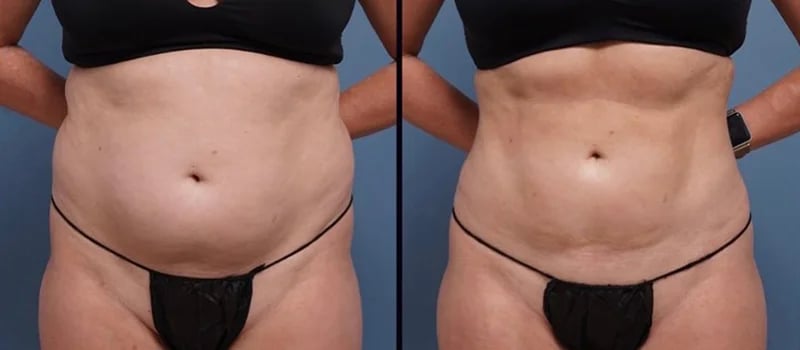
Energy-based skin tightening: what it can do
For patients in the middle groups, energy-based treatments are sometimes proposed. Radiofrequency and similar technologies heat the deeper layers of skin to stimulate collagen, and some are used during liposuction and others in separate sessions afterward. Dr. Bellamy's practice lists radiofrequency microneedling with Morpheus8 among its skin tightening tools, and its options are described under non-surgical rejuvenation. Whether a given tool suits the abdomen or flanks is a consultation question, so ask.
Set expectations carefully. These treatments can improve texture and firmness modestly, often across several sessions. They do not remove skin. If the lift test transformed your silhouette, they are not a substitute for surgery, and it is worth hearing that from a surgeon before spending money on a series of treatments that cannot deliver it.
When surgery is the honest answer: the tummy tuck family
If your results point to skin and muscle, here is the menu.
A mini tummy tuck addresses a small amount of skin below the navel, usually with a shorter scar. It suits a narrow group of people whose problem is confined to that lower area.
A full tummy tuck removes skin from the lower abdomen, tightens the abdominal muscles, and repositions the navel. It is the standard answer for stretched skin and diastasis. The scar sits low, usually hidden by underwear.
An extended tummy tuck carries the correction further around the sides. Some people call a circumferential version a "360 tummy tuck", a name that sounds like Lipo 360 and is not the same operation. It removes skin as well as fat.
Recovery for any of these is longer and more involved than for liposuction, typically with a compression garment, activity limits for several weeks and a scar that matures over a year or more. The comparison of Lipo 360 with a tummy tuck sets out the trade-offs side by side, and it is a useful next read.
When the problem goes all the way around: the lower body lift
Some patients, especially those who have lost a large amount of weight, have skin excess that is not limited to the front. It hangs at the flanks, across the lower back and sometimes over the buttocks and outer thighs. Removing skin from the front alone leaves the rest untouched.
A lower body lift, sometimes called a belt lipectomy, removes a band of skin and tissue around the lower trunk and lifts the buttocks and outer thighs as part of the same operation. The scar runs around the body at roughly the level of the underwear line. It is a larger operation with a longer recovery, and it is usually reserved for people whose problem genuinely is circumferential.
People search for terms like "lower body lift Palm Beach" and "excess skin removal surgery Palm Beach" because they have reached this stage and want to know who does it and what to expect. If this describes you, bring it up directly. Ask whether the practice offers it, how the plan would be staged and what recovery looks like. An honest answer will include what can and cannot be done in one operation.
After major weight loss
If your skin excess follows a large weight loss, timing is part of the plan. Surgeons generally want your weight to be stable, often for several months and sometimes longer after bariatric surgery, before operating. Operating too early risks doing the surgery twice. Nutrition matters too, since healing depends on protein and vitamins, and some patients need lab work first.
Medication-assisted weight loss deserves a mention. Rapid loss on newer weight loss medications can produce the same skin changes as other large losses, and the same principle applies: wait until weight has stabilized, and tell your surgeon what you are taking.
Costs, at the level of orientation
People ask whether a tummy tuck costs much more than liposuction, and the short answer is generally yes. For a national reference point, the American Society of Plastic Surgeons reported 2024 average surgeon's fees of roughly $4,300 to $7,500 for liposuction and roughly $8,000 to $13,500 for a tummy tuck, both excluding anesthesia and facility fees. The larger operation involves more surgical time and typically a longer recovery. Your own estimate follows an exam, and it is worth asking what each quote includes.
Bringing your results to a consultation
Your six tests are only useful if you bring them along. Before the visit:
- Save your photos: front, sides and back, relaxed and with the lift test.
- Write down your pinch and lift results in a sentence each.
- Note your history: pregnancies, weight changes, smoking, previous surgery.
- List your goals in your own words, ideally with a photo or two of the shape you want.
- Write your questions, particularly about skin.
Then ask the questions a surgeon should be comfortable answering. What do you see in my skin? Which of the three problems is the main one? What do you expect Lipo 360 alone to do for me, and what will it not? If I need more, what is the sequence? What is the recovery for each option? A surgeon who answers plainly, and who is willing to tell you when the less dramatic option is the right one, is doing the job properly.
Volume matters here too, because the amount of fat that can safely be removed with Lipo 360 in one sitting depends on setting and on what else is combined, and none of the technology labels on a clinic menu say much about how your skin will respond. Bring both questions to the same consultation and write down the answers before you leave the room.
A note for people who suspect they are group one
You may finish the tests and find that you really are mostly fat with decent skin. That is good news, and it is the best-case scenario for Lipo 360. It is still worth confirming with an exam, because skin and muscle problems that are hard to see in a mirror sometimes show up under a surgeon's hands. But do not talk yourself into surgery you don't need. The best outcome of an honest consultation is sometimes a plan smaller than the one you came in with.
The one-page version
- Fat, skin and muscle are three different problems, and liposuction treats only fat.
- The pinch, lie-down, bend, lift, head raise and stretch mark tests tell you which problem you have.
- Mostly fat with good skin points to Lipo 360.
- Loose skin or separated muscles point to a tummy tuck, with liposuction to refine.
- Circumferential excess, especially after major weight loss, may call for a lower body lift.
- Skin tightening treatments help modestly and do not remove skin.
- Skin keeps improving for months, so judge the result late, not early.
- Stable weight, no smoking and sun protection protect whatever you achieve.
- The most useful thing you can bring to a consultation is your own honest evidence.
Ten minutes with a mirror will not decide your surgery. It will make sure the conversation you have is about the right problem, and in cosmetic surgery, that is most of the battle.

Frequently Asked Questions
Can Lipo 360 remove excess skin?
No. Liposuction removes fat and leaves skin and muscle where they are. Skin retracts to some degree afterward, depending on age, genetics, sun exposure and weight history, but stretched skin that has lost its recoil usually needs to be removed surgically, as in a tummy tuck.
Will my skin tighten after Lipo 360?
It may retract partially as the fat beneath it shrinks, and the process continues for three to six months and can extend toward a year. Younger, elastic skin retracts best. If your skin is already thin and loose, expect less, and consider a tummy tuck instead.
Is there surgery to remove excess skin in Palm Beach?
Yes. Tummy tucks remove excess skin from the lower abdomen and tighten the abdominal muscles, and larger operations such as a lower body lift address skin around the whole lower trunk. Ask any surgeon which operation suits your pattern of excess skin and what recovery involves. Dr. Bellamy performs tummy tucks and will assess your needs at a consultation.
What is a lower body lift?
A lower body lift, or belt lipectomy, removes a band of excess skin and tissue around the lower trunk and lifts the buttocks and outer thighs. The scar runs around the body at about the underwear line. It is a larger operation reserved for people with circumferential loose skin, often after major weight loss.
What is the difference between Lipo 360 and a tummy tuck for loose skin?
Lipo 360 removes fat around the waist and does not remove skin. A tummy tuck removes excess skin, tightens the abdominal muscles and repositions the navel. If loose skin or muscle separation is your main concern, a tummy tuck usually works better, sometimes combined with liposuction.
Is a tummy tuck more expensive than liposuction?
Generally yes. For a national reference, the American Society of Plastic Surgeons reported 2024 average surgeon's fee ranges of roughly $4,300 to $7,500 for liposuction and $8,000 to $13,500 for a tummy tuck, excluding anesthesia and facility fees. Your estimate follows a consultation.
Can skin tightening treatments replace a tummy tuck?
They can improve texture and firmness modestly, often over several sessions, but they do not remove skin. If lifting your skin with your hands transforms your silhouette, surgery is the more effective option.
How can I tell whether it is skin, fat or muscle causing my belly pouch?
Pinch the skin to judge thickness and recoil, lie flat to see whether the bulge flattens, bend forward to see whether skin hangs, lift the skin upward to see how much of your look it explains, and raise your head while lying down to check for a ridge or dome down the midline. These are screening tests, and an in-person exam confirms the answer.
How long should I wait for surgery after losing a lot of weight?
Surgeons generally want a stable weight for several months, and often longer after bariatric surgery, before operating. Operating too early risks needing a second operation. Tell your surgeon about any weight loss medications you use.
What should I bring to a consultation about loose skin?
Bring photos from the front, side and back, your notes on the pinch and lift tests, your history of pregnancies, weight changes, smoking and prior surgery, and a list of goals and questions. That evidence helps the surgeon separate fat, skin and muscle quickly.
Bring Your Self-Test Results to Dr. Bellamy
An exam settles what a mirror cannot. Contact Bellamy Plastic Surgery to find out whether fat, skin or muscle is the main issue for you. Call (561) 705-0044 or complete our online contact form.