

Gynecomastia in Palm Beach is one of the most common reasons men walk into a plastic surgery consultation, and one of the most commonly misunderstood. Many men assume the fullness in their chest is simply stubborn fat, try diet and push-ups for years, and then assume a quick liposuction session will finish the job. Sometimes it does. Often it does not, because the tissue causing the problem is not fat at all. It is breast gland, and gland does not respond to cardio, calorie counting, or a suction cannula in the way fat does.
This guide explains the difference between true glandular gynecomastia, pseudogynecomastia (fat), and the mixed pattern most men actually have. It covers why liposuction alone can leave behind a puffy nipple, when excision is needed, what happens to the skin after major weight loss or GLP-1 medications, how revision cases differ, and what recovery really looks like in South Florida, where a shirt is optional for a good part of the year.
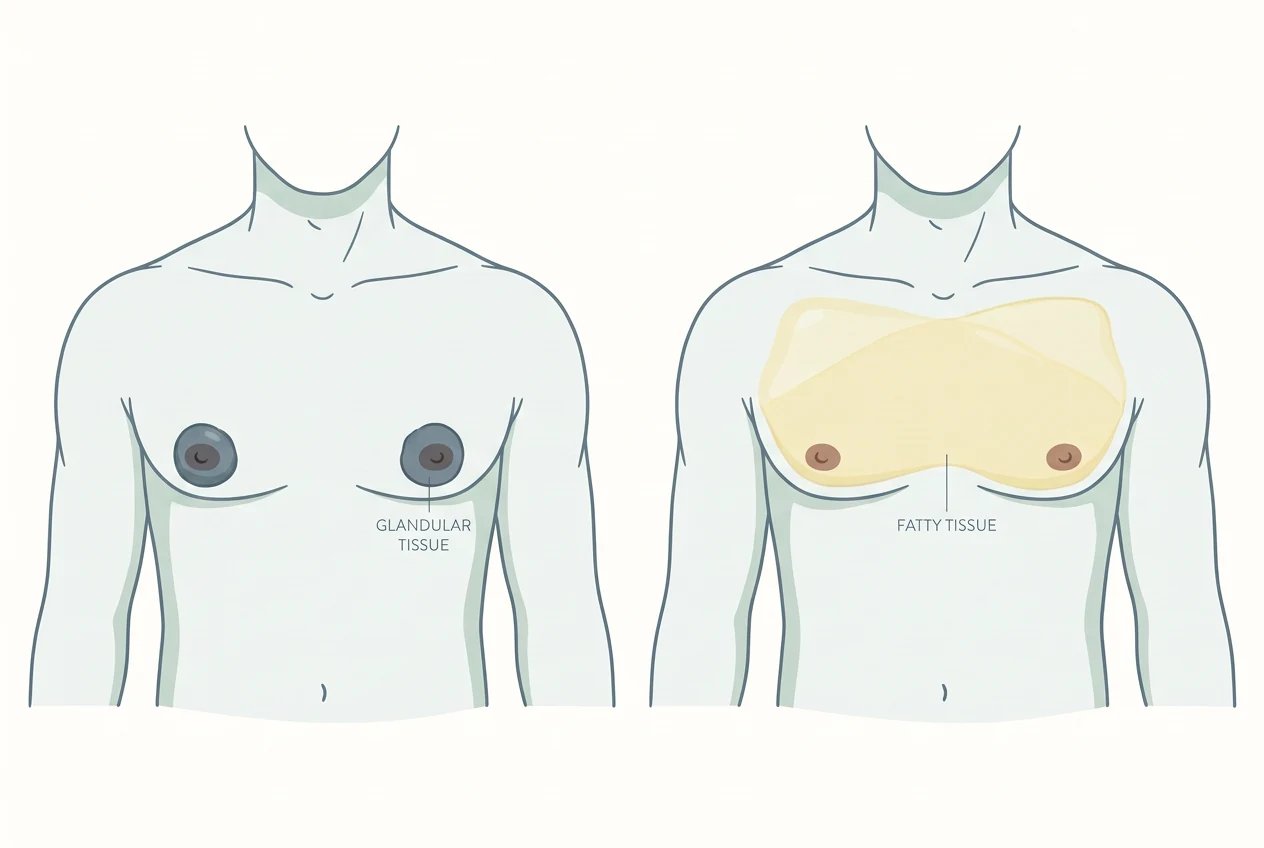
What Gynecomastia Actually Is
Gynecomastia is an enlargement of the male breast gland. Every man has a small amount of breast tissue sitting behind the nipple and areola. Under the influence of hormones, that tissue can grow into a firm, rubbery disc that pushes the nipple outward and creates the soft, rounded, or pointed chest contour men often describe as "puffy."
It is very common. It often appears during infancy and puberty, when hormone levels shift, and it can return later in life. Common contributors include normal hormonal changes with age, weight gain (fat tissue converts some testosterone to estrogen), certain prescription medications, anabolic steroid or prohormone use, some supplements, alcohol and recreational drug use, and, less often, underlying medical conditions involving the liver, kidneys, thyroid, or testes. In many men no single cause is ever found.
Because some of these causes are medical, a good evaluation starts with your history, not with the scalpel. New, rapidly enlarging, painful, or one-sided breast growth deserves a medical workup, and a hard, fixed lump (especially if it is not centered under the nipple) should be evaluated promptly by a physician to rule out other conditions. Once those questions are answered and the tissue has been stable for a while, gynecomastia surgery becomes a reasonable conversation.
Gland vs. Fat vs. Mixed: The Three Patterns
The single most important question in planning male breast reduction is what the tissue is made of. Surgeons use different terms, but in practical terms there are three patterns.
True Glandular Gynecomastia
In glandular gynecomastia, the fullness is concentrated directly behind the nipple and areola. It feels firm, dense, sometimes slightly tender, and it moves with the nipple. Many of these men are lean or athletic. They often say, "I have no body fat anywhere else, so why do I have this?" The answer is that the problem is not fat. Bodybuilders and men with a history of steroid use commonly fall in this group, as do men whose adolescent gynecomastia never fully resolved.
Pseudogynecomastia (Fatty Chest)
Pseudogynecomastia is fullness made mostly of fat. The chest feels soft and evenly padded, without a distinct disc under the nipple. It usually comes with fat elsewhere on the torso, such as the flanks and abdomen, and it often changes with weight. This is the pattern most likely to improve with weight loss, and it is the pattern where liposuction alone can do well.
Mixed Gynecomastia
Most men who seek surgery have a mix: a firm glandular core behind the nipple surrounded by softer fat that spreads toward the armpit and lower chest. The fat contributes to overall volume and width; the gland drives the projection of the nipple. Treating only one component tends to leave the other behind.
How the Patterns Compare
| Feature | Glandular | Fatty (pseudogynecomastia) | Mixed |
|---|---|---|---|
| How it feels | Firm, rubbery disc behind the nipple | Soft, evenly distributed | Firm center with soft surroundings |
| Typical body type | Often lean or muscular | Higher body fat overall | Any |
| Effect of weight loss | Little to none | Often meaningful improvement | Fat portion improves, gland persists |
| Main visual problem | Puffy or pointed nipple and areola | Rounded, wide chest fullness | Both projection and width |
| Usual surgical plan | Gland excision, often with some contouring liposuction | Liposuction, sometimes alone | Liposuction plus gland excision |
| Risk with lipo alone | High chance of residual puffy nipple | Lower, if skin quality is good | Moderate to high |
Why Liposuction Alone Often Fails on Glandular Tissue
Liposuction works by breaking up and suctioning out fat through a thin cannula. Fat is relatively soft and loosely organized, so it comes out readily. Breast gland is different. It is dense, fibrous tissue with a tough connective framework. A cannula tends to push it aside rather than remove it, and the volume that comes out may be much less than the visible fullness suggested.
The result is a pattern surgeons see often in men who come in after surgery elsewhere: the outer chest looks flatter and the overall size is reduced, but a firm mound remains right behind the nipple. With a fitted shirt or in direct sunlight, that small disc can look more obvious than before, because the surrounding fat that once blended it into the chest is now gone. Men describe it as a "puffy nipple that never went away."
That is why many surgeons who treat gynecomastia regularly plan for direct removal of the gland whenever a firm component is present. Liposuction is still valuable, because it shapes the borders of the chest and removes the fatty portion, but it is a tool for contour, not usually the whole answer. Some practices use energy-assisted or power-assisted liposuction devices that can loosen fibrous tissue more effectively, and those can help in selected cases. Even so, the dense core behind the areola commonly needs to be excised for a flat result.
The practical takeaway: if you can pinch a firm, rubbery disc under the nipple, ask how your surgeon plans to deal with it specifically. "We'll lipo it" is not a complete plan for that tissue.
Excision, Liposuction, or Both: Choosing the Right Technique
There is no single gynecomastia operation. The plan should match the tissue, the skin, and your goals.
Liposuction Only
Best suited to men with true pseudogynecomastia, good skin elasticity, and no meaningful gland. Incisions are tiny, placed where they are easy to hide, and recovery is usually the most straightforward. The same principles used in liposuction for body contouring apply here: careful, even fat removal and smooth transitions to the surrounding chest, flanks, and armpit.
Gland Excision Only
Some lean men have a small, isolated glandular disc with very little surrounding fat. A short incision along the lower edge of the areola, where the darker skin meets the lighter chest skin, allows the surgeon to remove the gland directly. That border usually hides the scar well once it matures. A thin layer of tissue is typically left under the nipple to prevent a sunken, "crater" look, which is one of the most visible complications of over-resection.
Combined Excision and Liposuction
For mixed gynecomastia, which is the majority, the most predictable approach is usually both: liposuction to remove and shape the fatty tissue across the chest and toward the armpit, plus excision of the firm glandular core through a small periareolar incision. Done well, this produces a flat chest with natural transitions and a nipple that sits flat rather than projecting.
Skin Removal
When the skin has stretched beyond its ability to recoil, removing tissue alone can leave loose or drooping skin and a low-sitting nipple. In those cases, a skin-tightening component is added. Options range from removing a ring of skin around the areola to larger excisions across the chest that may involve repositioning the nipple. These procedures leave longer scars, and the trade-off between scar and contour is a central part of the consultation.
Skin Excess After Major Weight Loss or GLP-1 Medications
More men in Palm Beach County are arriving at consultations after significant weight loss, whether through diet and training, bariatric surgery, or GLP-1 medications such as semaglutide or tirzepatide. Losing a large amount of weight can be excellent for health, but it changes the chest problem in two ways.
First, the fat portion often shrinks while any glandular disc stays exactly where it was, so the remaining fullness can look more like a classic puffy nipple than before. Second, the skin that once stretched over a larger chest may not fully retract. The result can be a deflated chest with some sagging, an inframammary fold that looks "female," and nipples that point downward.
A few principles apply here:
- Weight should be stable. Most surgeons prefer that you have reached and held a steady weight for several months before contouring surgery, so the result is not undone by further loss or regain.
- Skin quality matters more than volume. Two men with the same amount of tissue can need very different operations depending on how much the skin recoils.
- Tell your surgeon about medications. GLP-1 drugs and other medications can be relevant to anesthesia and surgical planning, and your surgeon and anesthesia team may give specific instructions about when to pause or continue them.
- Expect a longer scar if you need skin removal. Liposuction and gland excision cannot tighten significantly loose skin on their own.
If weight loss has also changed your neck and jawline, the same questions about fat, skin, and structure come up there. Some men address the chest first and consider chin liposuction later, once they see how their face settles at their new weight.
Gynecomastia Revision in Florida: When the First Surgery Did Not Work
A meaningful share of men searching for gynecomastia revision in Florida had a previous procedure that left them unhappy. Revision cases are more complex because the anatomy has been altered and scar tissue is present. The most common problems include:
- Residual gland: the classic puffy nipple after liposuction alone, where the firm core was never removed.
- Over-resection: too much tissue removed directly under the nipple, causing a crater or the nipple sticking to the muscle.
- Contour irregularities: dents, ridges, or uneven fat removal, sometimes visible as a step-off at the edge of the chest.
- Asymmetry: one side flatter or fuller than the other.
- Loose or excess skin: skin that did not retract after volume removal.
- Scar issues: wide, raised, or poorly placed scars.
Revision planning starts with a careful exam to separate residual gland from fat and scar tissue, and with honest expectations. Some issues, such as residual gland or remaining fat, are often very correctable. Others, like a significant crater from over-resection, may need staged work, fat grafting, or tissue rearrangement, and complete correction is not always possible. Most surgeons recommend waiting until the original surgery has fully healed, which commonly means at least six months to a year, before revising.
If you are looking for the best gynecomastia surgeon in Florida for a revision, look less at marketing language and more at whether the surgeon can explain clearly what went wrong the first time and exactly how the plan will differ.
Candidacy Self-Check: Is Your Chest Gland, Fat, or Both?
This self-assessment is not a diagnosis, but it helps you prepare for a male breast reduction consultation in West Palm Beach or anywhere else. Stand in front of a mirror with your shirt off, in good light, and work through the list.
Tissue
- When I pinch behind my nipple, I feel a firm or rubbery disc rather than soft tissue.
- The fullness is centered directly behind the areola rather than spread across the chest.
- My nipples look puffy or pointed, even when I am lean or after a workout.
- The fullness has not changed much despite losing weight.
Skin
- The lower edge of my chest folds over or hangs, especially when I lean forward.
- My nipples point downward or sit below the crease under my pectoral muscle.
- I have lost a large amount of weight in the past couple of years.
History
- The fullness has been stable for at least a year (or I have checked with a doctor about any recent change).
- I have used, or currently use, anabolic steroids, prohormones, or similar supplements.
- I take prescription medications that I have not reviewed with a doctor in relation to breast growth.
- I have had previous chest surgery or liposuction.
Readiness
- My weight has been steady for several months.
- I do not smoke or vape nicotine, or I am prepared to stop well before and after surgery.
- I can take time away from heavy lifting and chest workouts for several weeks.
How to read it: several checks in the Tissue group suggest a significant glandular component, which usually means excision is part of the plan. Checks in the Skin group raise the possibility of skin removal. A check for steroid or supplement use means your surgeon will want to discuss stopping them, because continued use can drive gland regrowth after surgery. Any check in the History group about recent change or unreviewed medications is a reason to see your physician first.
What the Surgeon Actually Evaluates in Consultation
For men comparing a gynecomastia expert in West Palm Beach with practices in Boca Raton or elsewhere, it helps to know what a thorough evaluation looks like. Expect your surgeon to:
- Take a full history, including onset, changes over time, medications, supplements, steroid use, alcohol, weight trends, and prior surgery.
- Examine the tissue by touch, feeling for a discrete glandular disc, its size, and its firmness, and comparing the two sides.
- Assess the skin, including thickness, stretch marks, elasticity, and where the nipple sits relative to the fold under the chest.
- Look at the overall frame, including chest width, pectoral development, flank and abdominal fat, and how the chest blends into the armpit.
- Check for asymmetry, since almost everyone has some, and discuss what can and cannot be balanced.
- Decide whether further testing is needed, such as bloodwork or imaging, if anything in the history or exam is unusual.
- Match the technique to the findings, explaining why you need liposuction, excision, skin removal, or a combination.
- Discuss anesthesia options, recovery, scars, and realistic results with photos where available.
Gynecomastia is one of several cosmetic procedures popular with men, and some patients plan treatments in sequence rather than all at once.
When Awake Surgery May Be an Option
Bellamy Plastic Surgery is known for performing selected procedures with the patient awake under local anesthesia rather than general anesthesia. For the right patient and the right operation, awake surgery under local anesthesia can mean avoiding a breathing tube, a quicker return to feeling like yourself on the day of surgery, and less of the grogginess some people associate with general anesthesia.

Whether a chest procedure can be done awake depends on several factors:
- Extent of the surgery. Limited liposuction or a small gland excision is generally more suited to local anesthesia than a large skin excision with nipple repositioning.
- Your comfort and anxiety level. Some men are very comfortable being awake; others strongly prefer to be asleep.
- Medical history. Certain health conditions and medications influence which anesthesia approach is safest.
- Surgeon judgment. The final recommendation should come from your surgeon after examining you, not from a general rule.
Recovery After Male Breast Reduction
Recovery depends on the technique, but most men follow a similar arc. Your surgeon's specific instructions always take priority over general timelines.
The First Week
Expect swelling, bruising, tightness, and soreness across the chest and sometimes toward the armpits. Discomfort is usually managed with prescribed or over-the-counter medication. Many men return to desk work within several days to a week. Some surgeons use small drains in larger excision cases; many liposuction-and-excision cases do not need them.
The Compression Vest
A compression vest is one of the most important parts of recovery. It helps control swelling, supports the skin as it adapts to the new contour, and helps reduce the risk of fluid collection (seroma). Many surgeons ask patients to wear it nearly around the clock for the first several weeks, then during the day for a further period. In the South Florida heat, a few practical tips help:
- Have at least two vests so one can be washed while you wear the other.
- Wear a thin, moisture-wicking undershirt beneath the vest if your surgeon approves, to reduce chafing.
- Keep the vest smooth and wrinkle-free; folds can leave temporary marks or pressure lines.
- Plan errands for cooler parts of the day for the first couple of weeks.
Weeks Two Through Six
Light walking is encouraged early to support circulation. Lower-body workouts and light cardio usually resume first. Chest exercises, push-ups, heavy lifting, and contact sports typically wait longer, often around four to six weeks, depending on how much tissue was removed and whether excision was performed.
Months Two Through Twelve
Most swelling resolves over the first few months, but subtle swelling and firmness can linger, particularly around the areola after excision. Scars are typically pink at first and fade gradually over a year. Protecting scars from the sun matters a great deal in Florida; follow your surgeon's scar care and sun protection advice.
Recovery Timeline at a Glance
| Timeframe | What to expect | Typical activity |
|---|---|---|
| Days 1 to 3 | Peak soreness, swelling, bruising | Rest, short walks, vest on |
| Week 1 | Bruising begins to fade | Many return to desk work |
| Weeks 2 to 3 | Swelling decreasing, contour emerging | Light cardio, lower-body training if cleared |
| Weeks 4 to 6 | Most daily discomfort resolved | Gradual return to chest training if cleared |
| Months 3 to 6 | Shape close to final, scars maturing | Full activity per surgeon |
| Month 12 | Final contour and scar maturity | Normal |
Living Shirtless: Why Results Matter in South Florida
Men in Palm Beach Gardens, Jupiter, West Palm Beach, and Boca Raton spend a lot of time in situations where the chest is on display: the beach, boat days on the Intracoastal, pool time, golf in a fitted polo, and workouts in tank tops. That context shapes what a good result looks like here.
A flat chest under a T-shirt is not the only goal. Results also need to hold up in direct sunlight, wet, and without a shirt, where small irregularities, a residual puffy nipple, or a crater from over-resection are easier to see. That is one reason careful handling of the gland behind the areola, smooth fat removal at the edges, and natural transitions toward the armpit matter so much.
Common Myths About Gynecomastia
"It's just fat, so losing weight will solve it." Weight loss helps pseudogynecomastia and the fatty part of mixed cases. It does not shrink a true glandular disc. The reverse is also true: liposuction is a contouring procedure, and understanding how much weight liposuction can realistically remove helps set expectations for the fatty portion of the chest.
"It always comes back." When gland is removed and the underlying cause (such as steroid use) is not ongoing, recurrence is uncommon. Weight gain, certain medications, or resuming anabolic steroids can cause new growth.
Choosing a Surgeon for Gynecomastia in West Palm Beach, Boca Raton, and Beyond
Men searching "male breast reduction near me" often see a long list of practices across Florida. A few questions help narrow it down:
- Is the surgeon board-certified in plastic surgery, and does the practice perform male chest procedures regularly? Reviewing a surgeon's training and focus, as you can with Dr. Justin Bellamy's background, is a sensible first step.
- Does the surgeon examine and explain whether your tissue is gland, fat, or mixed, and how that changes the technique?
- How does the surgeon handle the gland behind the areola, and how do they avoid over-resection?
- What is the plan if you have loose skin?
- What anesthesia options are available, and what is recommended for your case?
- Can you see before-and-after photos of men with chest types similar to yours?
- How are revisions handled if something needs adjustment?
Patients from Boca Raton, Fort Lauderdale, and the Treasure Coast often travel to Palm Beach Gardens for consultations. Ask whether an initial photo review or virtual consultation is available, and how follow-up visits work if you live farther away.
Final Note
At Bellamy Plastic Surgery in Palm Beach Gardens, gynecomastia planning starts with the same question this article is built around: what is the tissue made of, and what does the skin need? Dr. Bellamy evaluates the gland, the fat, the skin, and your overall chest shape, then explains which combination of liposuction, excision, or skin tightening fits your anatomy and your goals, including whether an awake approach under local anesthesia is appropriate for you.
Men often combine chest concerns with questions about other areas, such as the flanks, abdomen, or neck, and the team can help sequence treatments sensibly so recovery periods do not overlap more than necessary.
If you have been living with a puffy chest, a persistent puffy nipple after previous liposuction, or loose skin after weight loss, the next step is a conversation. You can request a consultation with Bellamy Plastic Surgery to have your chest examined and get a plan built around the tissue you actually have.
Frequently Asked Questions
How do I know if I have gynecomastia or just chest fat?
Feel directly behind your nipple. True gynecomastia usually presents as a firm, rubbery disc centered under the areola that moves with the nipple and does not shrink much with weight loss. Pseudogynecomastia feels soft and evenly spread across the chest and often changes with your weight. Most men have a mix of both. A hands-on exam by a plastic surgeon is the reliable way to tell, because the tissue type determines whether liposuction alone is likely to work or whether gland excision is needed.
Why do I still have a puffy nipple after liposuction?
The most common reason is residual glandular tissue. Liposuction removes fat well, but dense breast gland tends to resist the cannula and is often left behind. Once surrounding fat is removed, that firm disc under the areola can look more noticeable than before. Correction usually involves excising the remaining gland through a small incision at the lower edge of the areola, sometimes with touch-up liposuction. Revision is typically done after the first surgery has fully healed, often six months or more later.
Is male breast reduction in West Palm Beach done under local anesthesia?
It depends on the practice and on your specific case. Smaller procedures, such as limited liposuction or a small gland excision, are generally better suited to local anesthesia than large skin excisions. Bellamy Plastic Surgery is known for awake surgery for selected procedures, and whether that applies to your chest procedure is decided after an exam. Your medical history, the amount of tissue, and your comfort level all factor into the recommendation.
How long do I need to wear a compression vest after gynecomastia surgery?
Many surgeons recommend wearing the vest nearly full time for the first several weeks, then during the day for an additional period. The vest controls swelling, supports the skin as it adapts, and helps reduce the risk of fluid buildup. The exact schedule varies with the technique and the amount of tissue removed, so follow your surgeon's instructions. In South Florida heat, having two vests and a thin moisture-wicking undershirt makes the process much more comfortable.
When can I go back to the gym after gynecomastia surgery?
Walking is encouraged right away. Light cardio and lower-body workouts often resume within about two to three weeks if your surgeon clears you. Chest exercises, push-ups, heavy upper-body lifting, and contact sports usually wait longer, often around four to six weeks, particularly after gland excision. Returning to heavy chest training too soon can increase swelling and the risk of fluid collection, so build back gradually.
Can gynecomastia come back after surgery?
Recurrence is uncommon when the gland has been removed and the underlying cause is no longer active. New growth can occur with significant weight gain, certain medications, or the use of anabolic steroids, prohormones, or some supplements. If steroid use contributed to your gynecomastia, your surgeon will likely ask you to stop before surgery and avoid resuming afterward. Keeping a stable weight also helps protect the result.
Will I need skin removed after losing weight on a GLP-1 medication?
Not necessarily. Many men with good skin elasticity do well with liposuction and gland excision alone. If the skin has stretched significantly, the nipples point downward, or the lower chest folds over, a skin-tightening component may be recommended, which adds scars. Most surgeons prefer your weight to be stable for several months first, and they will want to know about GLP-1 medications for anesthesia and surgical planning.
What is gynecomastia revision and who is a candidate?
Gynecomastia revision corrects problems from a previous chest surgery, such as a residual puffy nipple, a crater from over-resection, contour irregularities, asymmetry, or loose skin. Candidates are men who are fully healed from their first procedure, typically six months to a year later, have stable weight, and have realistic expectations. Residual gland and fat are often very correctable, while significant over-resection may need more complex or staged techniques.
Do men travel from Boca Raton for gynecomastia surgery in Palm Beach Gardens?
Yes. Patients from Boca Raton, Fort Lauderdale, Jupiter, and the Treasure Coast commonly travel to Palm Beach Gardens for consultation and surgery. If you live farther away, ask about an initial photo review or virtual consultation, how many in-person follow-up visits to expect, and when it is safe to drive after surgery. Plan to stay local or have a driver available on surgery day.
Does gynecomastia surgery leave visible scars?
Liposuction uses tiny incisions that are typically placed in discreet locations and fade well. Gland excision is usually done through an incision along the lower edge of the areola, where the color change helps camouflage the scar once it matures. Skin removal procedures leave longer scars, which is the trade-off for tightening loose skin. Scars fade gradually over about a year, and diligent sun protection is especially important in Florida.
Find Out Whether Your Chest Is Gland, Fat or Both
An exam answers what a mirror cannot. Contact Bellamy Plastic Surgery to request a gynecomastia consultation with Dr. Bellamy. Call (561) 705-0044 or complete our online contact form.